Redbubble Alternatives Compared: choosing Marketplace or POD supplier
Explore Redbubble alternatives split into two models: marketplaces like Society6 and Zazzle, or POD suppliers like Printify and Printful. Find your fit.
· UPDATED · 5 MIN

If you have spent any time selling art online, you already know Redbubble's appeal: upload a design, and a global platform handles printing, shipping, and customer support while you draw more. But most sellers eventually hit the same wall: thin margins and no brand to call their own. This guide takes a different approach to Redbubble alternatives. Instead of listing ten interchangeable sites, it reframes the real decision: choosing the right business model. Broadly, your options split into two camps: third-party marketplaces and white-label POD suppliers, and each serves a very different goal. Companies like Redbubble aren't your only path, and other sites like Redbubble aren't automatically better either.
Why Look for a Redbubble Alternative?
The most common question (is Redbubble worth it) has become harder to answer since recent fee restructures. Three major frustrations drive most professional-minded sellers to look elsewhere.
First, profit margins are highly restricted. The platform keeps a major cut of every sale. Under the Redbubble tiered account fee system, standard accounts are charged fees that can consume up to 50% of monthly earnings, heavily reducing your actual margins (checked October 2026).
Second, there is zero branding control. Every sale builds Redbubble's brand, not yours. The customer belongs entirely to the platform; you never learn who bought your work, leaving you unable to market to them again.
Third, intense competition makes organic discovery difficult. With over 2.8 million artists on the platform, your work sits alongside thousands of highly similar designs on the same product pages.
Consider a quick math comparison. Selling a t-shirt on Redbubble for $24 with a standard base price of $19.17 yields a 20% markup of $3.83. On the Standard tier, half of that disappears in fees, leaving you under $2.00. Using a POD supplier, a high-quality Bella+Canvas 3001 base cost starts at $11.29 on Printify (checked October 2026). Sell that same shirt on your own Shopify store for $24 and you keep roughly $13.00 before shipping and transactional fees.
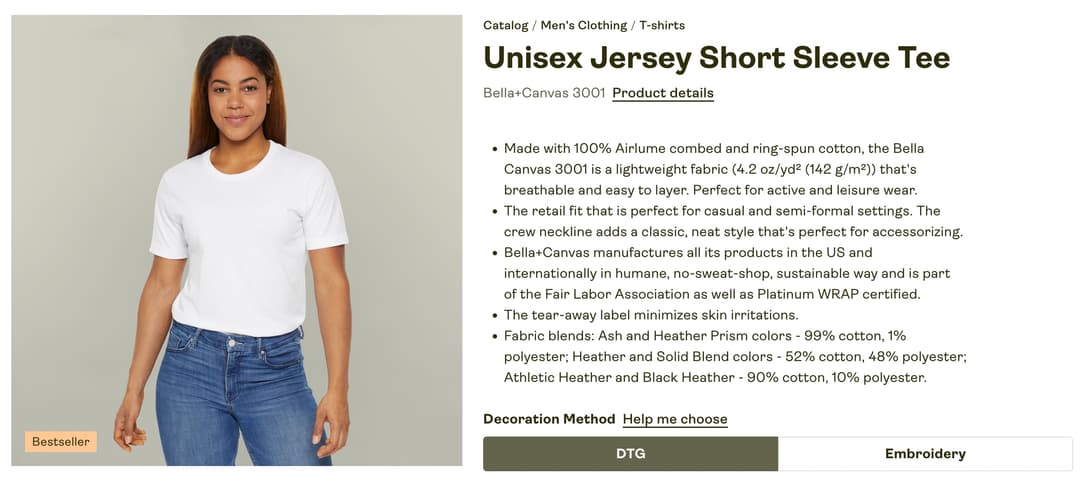
Source: Printify
The Core Choice: Marketplace vs. POD Supplier
Before evaluating specific platforms, you must understand the two core business models. This is your primary decision framework.
A POD supplier (Printify, Printful) plugs into a store you own. You handle fulfillment through them, but you set
prices, own the branding, and keep the customer relationship. The trade-off is traffic: no one visits your store unless you bring them there via platforms like Shopify, Etsy, or WooCommerce.
A marketplace (Redbubble, Society6, TeePublic) hosts your designs, drives traffic, and manages fulfillment. You get built-in buyers in exchange for lower profit margins and limited control.
| Criteria | Marketplace | POD Supplier |
|---|---|---|
| Effort to Start | Low (upload and publish instantly) | Higher (must build a store) |
| Built-in Traffic | Yes (platform search engine) | No (you must drive visitors yourself) |
| Profit Potential | Lower (fixed platform royalties) | Higher (you control wholesale margins) |
| Branding Control | None (platform packaging) | Full (custom neck labels and pack-ins) |
| Customer Ownership | Platform owns buyer data | You own the customer email list |
| Quality Control | Fixed by platform | You choose specific print providers |
Neither model is objectively superior. Marketplaces suit passive experimentation; POD suppliers suit a deliberate brand.
Best POD Supplier Redbubble Alternatives
If your goal is a durable brand, a POD supplier integrated with your own store is the path. Here, integrations with platforms like Shopify, Etsy, or WooCommerce are critical.
Printify operates a vast network of print providers. This model creates price competition, resulting in lower base costs. The trade-off is consistency: because fulfillment is outsourced, quality can vary by provider, so ordering samples is vital. To evaluate your profit potential, look at Printify's current deals and pricing, which offer substantial savings through their Premium subscription tier, reducing base costs by up to 20% on most items (checked October 2026).
Printful manufactures most products in-house, owning the factories and controlling production from start to finish. This ensures consistent print quality and predictable branding, although base costs are higher than Printify's network rates. While both companies announced a merger in late 2025, they continue to run as separate, independent systems.
Sellfy is a strong option if you do not already run a store. It is an all-in-one e-commerce solution with built-in print-on-demand features, bundling your storefront, digital products, and physical fulfillment in one setup.
Best for...
- Printify: Cost-conscious sellers who want competitive pricing via a diverse print network.
- Printful: Brand builders who prioritize consistent quality and in-house fulfillment.
- Sellfy: Creators who want an all-in-one store and POD without managing separate platforms
Best Marketplace Alternatives to Redbubble
If you prefer a hands-off approach, several sites like redbubble are worth investigating. These redbubble like sites manage production but target slightly different audiences.
Society6 is highly regarded for home decor and wall art. However, artists now earn flat commission rates ranging from 5% to 10% of the net sale amount on most items, making it less viable for apparel but excellent for fine art.
Best for...
Society6: Artists focusing on premium wall art and home decor.
Zazzle focuses on deep customization for events. Zazzle exposes your designs to over 30 million active customers. You set your own royalty percentage, though setting it above 15% can penalize search visibility.
Best for...
Zazzle: Sellers who want to offer deep product customization to customers.
TeePublic is owned by Redbubble but operates separately, specializing in graphic tees. TeePublic's earnings policy dictates fixed pricing: standard tees sell for $22, earning you a flat royalty of $4, which drops to $2 during promotions (checked October 2026). Spreadshirt is another hybrid option to consider.
Best for...
TeePublic: Illustrators wanting a fast, straightforward path to live graphic-tee listings.
The Verdict: Which Model Is Right For You?
There is no single winner, only the right fit for your business goals. Use these simple guidelines:
- If you want passive income with minimal marketing effort, then a marketplace like Society6, Zazzle, or TeePublic is your best starting point.
- If you sell highly customizable or event-based products (wedding suites, invitations), then Zazzle's model fits perfectly.
- If you want to build a long-term brand and maximize your profit margins, then a POD supplier integrated with your own store is the clear winner.
- If you are a brand builder but do not yet have a store, then Sellfy's all-in-one setup lowers the technical barrier.
Many professional sellers utilize a hybrid approach: listing experimental designs on marketplaces for low-risk testing, while moving their best-performing concepts to a dedicated, high-margin Shopify store.
Putting It All Together
Choosing Redbubble alternatives is a strategic decision first and a platform decision second. Marketplaces trade control for built-in traffic, while POD suppliers trade traffic generation for complete brand ownership and higher margins. Neither companies like Redbubble nor other sites like Redbubble are inherently superior; the correct choice matches how you want to work and how you define success. Pick the path that fits your entrepreneurial vision and commit to it fully.
FAQ
Can I use my same designs on both Redbubble and a self-hosted Shopify store?
Yes. Unless you sign an exclusive licensing agreement, you retain full ownership of your intellectual property. You can upload the same designs to marketplaces like Zazzle while simultaneously selling them through your own store using Printify or Printful.
How do shipping times compare between marketplaces and POD suppliers?
Marketplaces handle shipping internally and often use economy carriers, which can result in unpredictable delivery times. POD suppliers like Printful offer expedited shipping options and real-time tracking directly integrated with your storefront, giving you greater control over the customer experience.
Is Shopify or Etsy better for connecting a POD supplier?
Etsy provides some built-in search traffic, making it easier for new brands to get noticed, though it charges listing fees. Shopify is a fully independent platform with no built-in traffic, meaning you must market your store yourself, but it offers complete branding freedom.
Keep reading
- Printful vs Redbubble: Supplier vs Marketplace
Printful vs Redbubble: compare margins, branding, and customer ownership to see which print-on-demand model actually fits the store you want to run.
- Best POD for Custom Jewelry in 2026: 4 Platforms Compared
Find the best platform for your custom jewelry business in 2026. We compare 4 top POD services on product range, engraving quality, base costs, and more.
- 7 Best Sellfy Alternatives for Digital and POD Creators
Searching for Sellfy alternatives? We compare the top 7 platforms on pricing, features, and ease of use to help you find the right fit for your digital and physical products.