7 Best Sellfy Alternatives for Digital and POD Creators
Searching for Sellfy alternatives? We compare the top 7 platforms on pricing, features, and ease of use to help you find the right fit for your digital and physical products.
· UPDATED · 11 MIN
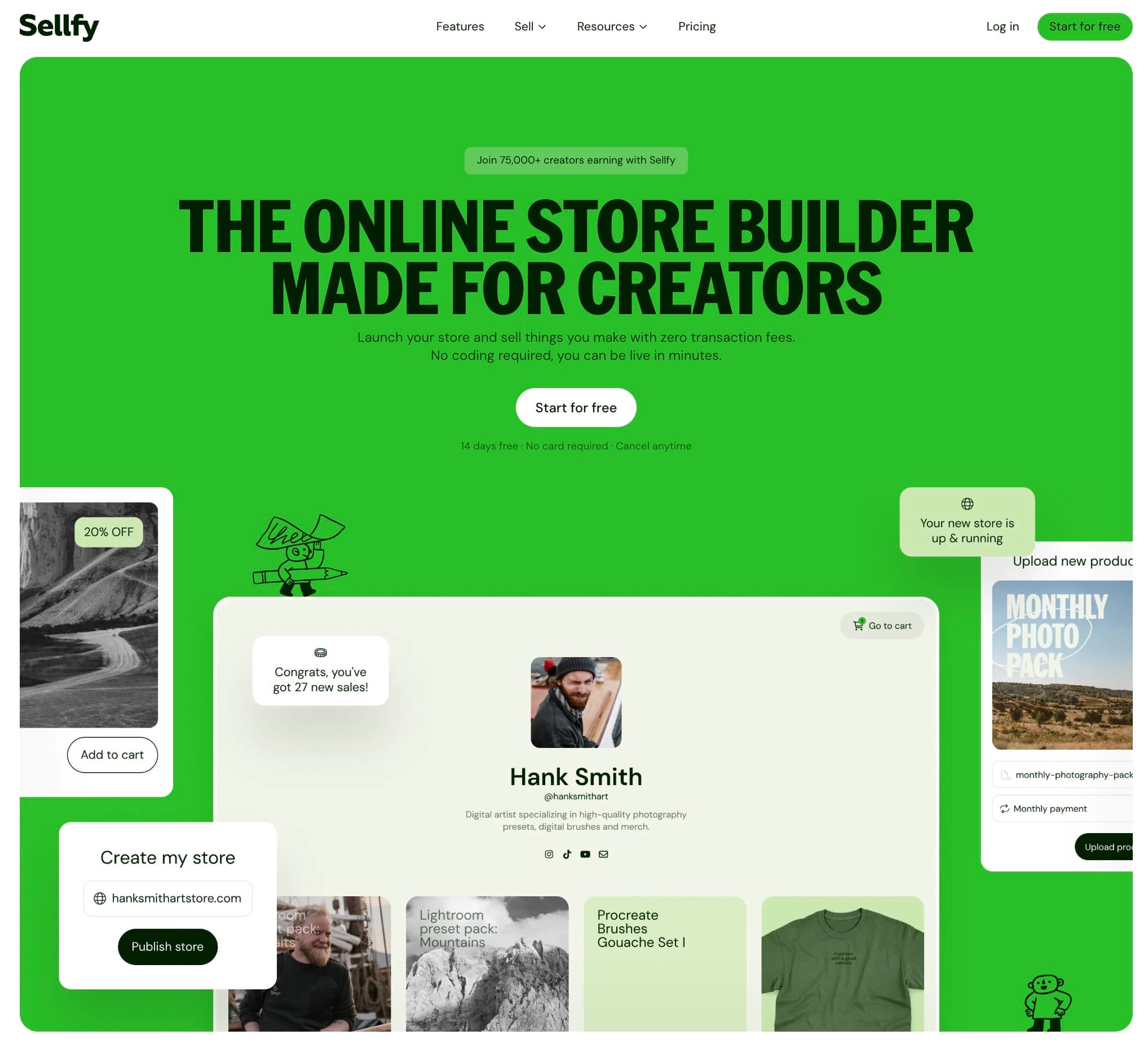
Sellfy has earned its reputation as a straightforward e-commerce solution for creators. It excels at providing a simple, clean interface for selling digital products, subscriptions, and basic print-on-demand items directly to an established audience. For many, its all-in-one approach is highly effective.
However, creators may seek a Sellfy alternative for several reasons. The subscription-only pricing model can be a barrier for those just starting or testing a new product idea. As a business grows, the platform’s features for course delivery or advanced merchandise fulfillment can feel limiting compared to more specialized tools. The right platform is a critical business decision, and the best choice depends entirely on your specific products, audience, and long-term goals.
This article provides a clear, criteria-based comparison of the top five sellfy alternatives, examining the specific trade-offs of each. We will help you identify the platform that best aligns with your creative business, whether you're selling your first eBook or scaling a global brand.
Our Criteria for Evaluating Sellfy Alternatives
To provide a fair and useful comparison, we evaluated each sellfy alternative against a consistent set of criteria that reflects the core needs of creative entrepreneurs. In our testing, we focused on the practical trade-offs each platform presents, moving beyond marketing claims to assess real-world performance. This methodical approach ensures our recommendations are grounded in evidence. Our evaluation criteria are as follows:
- Product & Fulfillment Types: A creator's primary need is to sell their specific product, so this is our first test. We assess how well a platform supports digital downloads, online courses, memberships, and physical goods. For merchandise, we look at the quality and ease of its native print-on-demand (POD) features or its ability to integrate smoothly with third-party fulfillment services. A platform that excels at eBooks may not be suitable for a complex apparel line, and vice versa.
- Pricing & Transaction Fees: The cost structure directly impacts profit margins. We analyze monthly subscription fees, transaction percentages, and any hidden costs like payment processor fees. We consider the overall value for money, evaluating whether a platform with higher fees is justified by features that generate more revenue. A zero-upfront-cost model is ideal for validation, while a subscription may be more cost-effective at high sales volumes.
- Ease of Use & Customization: Creators need tools that are powerful yet intuitive. We measure how quickly a non-technical user can set up a functional, attractive storefront. We also evaluate the degree of brand customization available, from simple logo uploads to full CSS control. The ideal platform strikes a balance, offering a simple onboarding process without restricting a brand's unique identity.
- Marketing & Sales Tools: A platform should not just host products; it should help sell them. We examine the suite of built-in marketing tools, including email marketing capabilities, discount and coupon code systems, affiliate program management, and features for upselling or cross-selling to increase average order value.
The 7 Best Sellfy Alternatives Reviewed
Printify
Printify takes a marketplace approach to print-on-demand: instead of owning production, it connects sellers to a large network of independent print providers who compete for each order. Because providers compete on price, base costs on core products routinely land a few dollars below in-house rivals, and at meaningful order volume that adds up to real margin. The catalogue is also the largest in the category, and for each product, a seller can compare providers side by side on price, location, and rating, letting a store optimise for cost, speed, or quality on a per-product basis. Its free tier is a genuine option rather than a stripped-down trial, and a Premium subscription adds up to a 20% discount on base product costs along with priority support and order-tracking tools for sellers doing consistent volume.
The trade-off is that Printify's strength (provider choice) is also its main source of friction. Quality and fulfillment consistency shift from being the platform's job to the seller's job: ordering samples, vetting providers, and monitoring feedback becomes part of the workflow rather than something guaranteed out of the box. It's also a fulfillment tool, not a storefront, so it still needs to sit behind Shopify, Etsy, or another sales channel. Printify suits creators who are comfortable doing that provider homework in exchange for the widest product catalog and the strongest margins in the print-on-demand space.

Printful
Printful is the most vertically integrated Sellfy alternative on this list, running its own production facilities rather than routing orders to third-party partners. This in-house model across more than 15 facilities is what gives Printful its reputation as the most polished print-on-demand platform available, with consistent quality and a native Shopify integration that makes the unboxing experience look professional. Its free plan is unusually generous by industry standards: creators get full access to hundreds of products, all major ecommerce integrations including Shopify, Etsy, and WooCommerce, and the complete design toolset without paying anything beyond the base product cost. For sellers who outgrow that, an optional Growth plan unlocks discounts of up to 33% on products and becomes free once a store hits $12,000 in annual qualifying sales (checked October 2026).
The trade-off is cost and scope. Printful is, by most comparisons, the most expensive platform in its category, and like Printify, it isn't a storefront in its own right: it connects to Shopify, Etsy, or a similar front end rather than replacing one. It also has nothing to offer someone selling a pure digital product like an eBook or a course; its entire value proposition is physical merchandise. Printful is best for creators who have already decided merchandise is central to their brand and are willing to pay a premium for print quality and fulfillment consistency over the lowest possible per-unit cost.

Gumroad
Gumroad is arguably the most direct Sellfy alternative, built on a foundation of radical simplicity. Its primary strength lies in its frictionless onboarding and zero-upfront-cost pricing model. A creator can sign up and list a digital product for sale in minutes without committing to a monthly subscription. This makes it an exceptional platform for validating a new product idea or for creators who sell infrequently and want to avoid recurring fees.
The platform handles digital file delivery, VAT collection, and direct payouts effectively. It supports a range of products, including digital downloads, subscriptions, and pre-orders. However, this simplicity comes with significant trade-offs. Gumroad’s fee is a flat 10% plus $0.50 per sale, rising to 30% on sales that come through its Discover marketplace, which is among the highest in the market (checked October 2026). This model becomes less cost-effective as sales volume grows. Customization is also minimal; while you can add a banner and bio, your product pages will look distinctly like Gumroad pages, offering little room for unique branding. In our testing, its marketing tools are basic, covering discounts and simple email updates but lacking the sophisticated funnels or course-building features of its competitors. Gumroad is best for speed and simplicity, not for building a complex, branded e-commerce presence.
Payhip
Payhip positions itself as a more feature-rich competitor to Gumroad, offering a similar no-upfront-cost entry point. Its free plan is compelling, including support not just for digital downloads but also for online courses, coaching services, and memberships, features often reserved for paid tiers on other platforms. This makes it a strong contender for creators who want to experiment with different digital product formats without a financial commitment. Payhip also charges a lower transaction fee on its free plan (5%) than Gumroad, making it more profitable from the first sale (checked October 2026).
On balance, while Payhip is strong on features, its user experience can feel slightly less polished than more established platforms. The storefront builder offers more customization options than Gumroad, including an embeddable cart and checkout for existing websites, but it may not feel as intuitive as Podia or Shopify. Marketing tools are robust for a free platform, including affiliate marketing, cross-selling, and coupon codes. The primary trade-off with Payhip is a less refined interface in exchange for a wider feature set at a lower cost. It is an excellent choice for budget-conscious creators who need more functionality than Gumroad but are not yet ready for a full subscription-based service.
Podia
Podia is an all-in-one platform designed for creators whose business centers on knowledge commerce: online courses, webinars, and paid communities. While it capably handles digital downloads, its core strength is its integrated suite of tools for building and selling educational content. With Podia, you can host your course videos, build a community forum, run an affiliate program, and manage email marketing campaigns all from a single dashboard, with no transaction fees on paid plans. This unified system is its main value proposition, eliminating the need to connect multiple disparate services.
This integrated approach, however, means Podia can be overkill for a creator focused solely on selling a single digital download or a line of merchandise. Its monthly subscription cost is higher than entry-level plans on other platforms, reflecting its focus on a comprehensive feature set. While it offers a free plan, its features are limited compared to its paid tiers. In our testing, the storefront customization is functional but more template-based than a platform like Shopify, prioritizing ease of use over deep brand control. Podia is the ideal Sellfy alternative for educators and community builders who value an integrated, user-friendly system for their core business and see digital downloads as a supplementary offering.
Shopify
Shopify represents the next step for creators ready to build a serious, scalable e-commerce brand. While Sellfy offers a simple storefront, Shopify provides a powerful, endlessly customizable platform capable of handling high-volume sales of both digital and physical products. Its primary strength is its vast ecosystem of apps and integrations. You can add any functionality imaginable, from advanced analytics to sophisticated subscription tools. For creators focused on merchandise, this can be paired with a production partner like Printify, which integrates directly to handle fulfillment. The platform's digital download capabilities are managed through free or paid apps, offering secure file delivery and license key generation.
The trade-off for this power is complexity and cost. Setting up a Shopify store requires more time and effort than any other platform on this list. While its theme editor is user-friendly, unlocking its full potential often involves working with apps that may carry their own subscription fees, in addition to Shopify's monthly plan. For a creator selling a single eBook, Shopify is an unnecessarily complex and expensive solution. However, for those building a long-term brand with a diverse product catalog, its scalability, powerful checkout, and marketing tools provide a professional foundation that can grow with the business.
Etsy
Etsy offers a fundamentally different approach compared to other Sellfy alternatives. Instead of providing a tool to build your own standalone store, it is a massive online marketplace. Its greatest strength is access to a vast, built-in audience of millions of shoppers who are actively searching for unique products, including digital downloads like art prints, planners, and templates. For a new creator without an existing audience, this immediate access to potential customers can be invaluable for generating initial sales and gathering market feedback.
This built-in traffic comes at a cost. The primary trade-off is a significant lack of brand control and ownership. Your shop exists within the Etsy ecosystem, subject to its rules, design constraints, and algorithm changes. Competition is also fierce, making it difficult to stand out. Furthermore, Etsy's fee structure is complex, combining listing fees, transaction fees, payment processing fees, and optional offsite ad fees, which can add up quickly and erode profit margins. While it is an excellent channel for product discovery and reaching new customers, most serious creators use Etsy as a supplementary sales channel rather than the primary home for their brand. It is best used for market validation, not for building a long-term, independent business.
Comparison Table & Use-Case Recommendations
To help you find the best sellfy alternatives at a glance, the table below summarizes the key differences between each platform. We have included Sellfy for direct comparison.
| Platform | Best For | Pricing Model | Transaction Fees | Key Features |
|---|---|---|---|---|
| Sellfy | Simplicity for digital & POD products | Subscription | 0% + processor fees | Built-in POD, digital subscriptions, simple store |
| Fees checked in October 2026 against each platform’s own pricing page: Printful, Printify, Gumroad, Payhip, Podia, Shopify, Etsy and Sellfy. |
| Printify | Widest product catalog and the strongest margins via provider competition | Free & Premium Subscription | 0% (base cost + shipping per order; providers vary) | Large print-provider marketplace, side-by-side provider comparison, biggest catalog | | Printful | Merch quality and brand consistency | Free & Growth Subscription | 0% (base cost + shipping per order) | In-house fulfillment network, native storefront integrations, branded packaging | | Gumroad | Validating products with no upfront cost | Transaction Fee Only | 10% + $0.50 per sale | Extreme simplicity, email broadcasts, pre-orders | | Payhip | Free plan with robust features | Free & Subscription Tiers | 0-5% + processor fees | Free courses & memberships, affiliate marketing | | Podia | Courses, webinars, and communities | Free & Subscription Tiers | 5% on the entry plan | All-in-one course builder, community, email | | Shopify | Scaling a full e-commerce brand | Subscription | 0.6–2% + processor fees | App ecosystem, full customization, advanced tools | | Etsy | Accessing a built-in customer base | Listing & Transaction Fees | 6.5% + other fees | Marketplace exposure, simple listing process |
Based on our analysis, here are our direct recommendations to help you self-select the right platform:
- Choose Printify if: you want the widest product catalog and the strongest possible margins, and don't mind doing sample orders and provider vetting to keep quality consistent.
- Choose Printful if: merchandise quality and brand consistency matter more than shaving every dollar off your per-unit cost, and you want production handled in-house.Choose
- Choose Podia if: your primary business is selling online courses, hosting webinars, or running a paid community. Its all-in-one toolset is its main advantage.
- Choose Shopify if: you are building a long-term brand and plan to sell a significant volume of physical merchandise alongside digital goods. Its scalability is unmatched.
- Choose Etsy if: you need to tap into an existing customer base to make your first sales and do not have your own audience yet.
Conclusion
Choosing to move from Sellfy or selecting a sellfy alternative from the start involves a clear set of trade-offs. There is no single "best" platform, only the right platform for your specific goals. The decision hinges on your product type, business maturity, and priorities.
On balance, Gumroad offers the simplest, no-cost entry point for validating an idea. Podia provides an excellent integrated system for course creators, while Shopify delivers the power and scalability needed to build a major e-commerce brand. By evaluating your needs against the criteria we have outlined, you can confidently select the tool that will best serve your creative business.
FAQ
What is Sellfy?
Sellfy is an e-commerce platform designed for creators to sell digital products, subscriptions, and print-on-demand merchandise directly from their own storefront.
What is the best free Sellfy alternative?
For a completely free start, Gumroad and Payhip are the strongest alternatives, operating on a transaction fee model instead of a monthly subscription.
Is Sellfy good for print-on-demand?
While Sellfy offers a built-in print-on-demand service, its product range is more limited than dedicated POD platforms, making it better for simple merchandise than a full apparel brand.
Can I migrate from Sellfy to another platform?
Yes, you can typically export your product and customer data from Sellfy, but the process and ease of importing it will vary depending on the platform you choose.
Keep reading
- Teespring Alternatives: 4 Top Platforms for Creators in 2026
Searching for reliable Teespring alternatives? We compare 4 top print-on-demand platforms on print quality, profit margins, and integrations to help you choose the best fit for your brand.
- Redbubble Alternatives Compared: choosing Marketplace or POD supplier
Explore Redbubble alternatives split into two models: marketplaces like Society6 and Zazzle, or POD suppliers like Printify and Printful. Find your fit.
- POD White-Label Packaging: Which Platforms Offer It in 2026?
Looking for white-label packaging for your print-on-demand store? We compare the branding options, costs, and features of top POD platforms in 2026.