Prodigi vs. Printful: Which Is Better for International Sellers?
Prodigi vs Printful (2026): A detailed comparison for international sellers. We analyze fulfillment networks, cross-border fees, and product quality to help you choose.
· 8 MIN
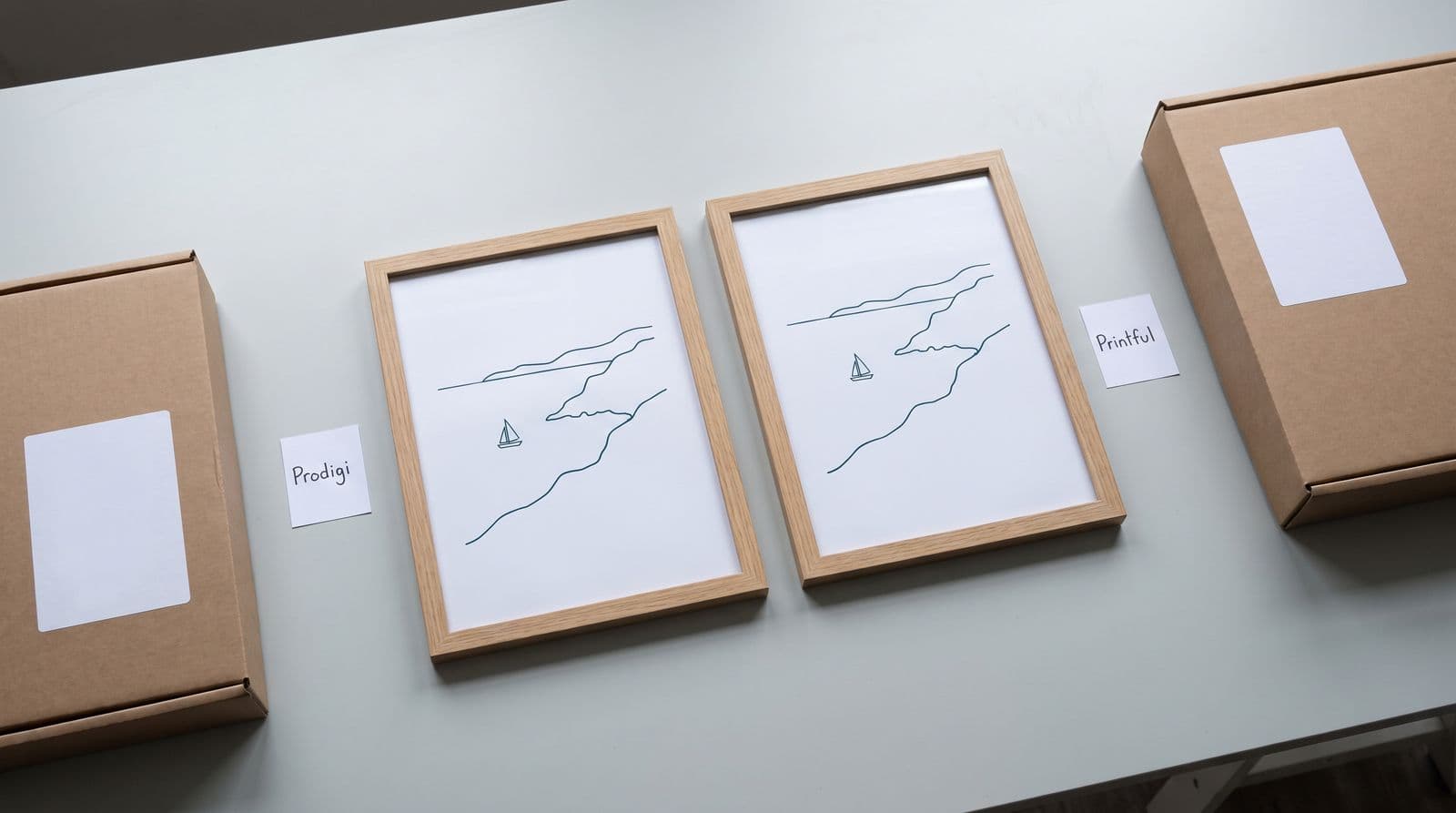
Selling print-on-demand products to a global audience presents a significant opportunity, but it also introduces operational challenges. High shipping costs, long fulfillment times, inconsistent product quality across borders, and complex international taxes can quickly erode profit margins and damage a brand’s reputation.
Choosing the right print-on-demand partner is critical to navigating these issues. The two dominant operational models present a clear choice: a distributed network of in-house and partner facilities, exemplified by Prodigi, and a vertically integrated system of in-house fulfillment centers, the model used by Printful. Each comes with a distinct set of trade-offs for the international seller.
This article provides a direct comparison of Prodigi vs. Printful, focusing on the criteria that matter most for global e-commerce. We will analyze each platform’s fulfillment network, regional product availability, approach to cross-border pricing, and the resulting impact on quality consistency to help you make an informed decision for your business.
Disclosure: POD Platform Review is part of the Printful family. This review, like all our comparisons, is conducted with strict editorial independence. We evaluate every platform against the same published criteria to ensure our analysis is fair, balanced, and useful for our readers.
Verdict at a Glance: Prodigi vs. Printful
For sellers building an international print-on-demand business, the choice between Prodigi and Printful hinges on a core trade-off: Prodigi offers expansive global reach through its partner network, while Printful provides deep control and consistency through its in-house operations. Your business priorities will determine which is the better fit.
- Prodigi is best for: Sellers who prioritize localized production in the widest possible range of countries, especially those focusing on fine art prints and wall art where specialized local labs are an advantage.
- Printful is best for: Brand-focused sellers who prioritize high levels of quality consistency, standardized branding options, and simplified tax handling across all regions.
The decision is a strategic one. Prodigi’s strength is its breadth, offering access to a vast network that can reduce shipping distances. Its weakness is the inherent variability that comes with using many different suppliers. Printful’s strength is its control, ensuring a customer in Tokyo receives the same quality product and branding as a customer in London. Its weakness is that its fulfillment network is more consolidated, which may result in longer shipping routes for some less common destinations.
| Feature | Prodigi | Printful |
|---|---|---|
| Fulfillment Model | Own facilities in the UK, US, and Netherlands plus a network of 50+ print facilities in 10+ countries | Primarily in-house facilities with some partners |
| Global Reach | Extremely wide; localized production in many countries | Strong presence in key markets (N. America, Europe, UK, AU) |
| Quality Consistency | Can vary between different print partners | High and standardized across in-house facilities |
| Branding Options | Varies by product and partner | Standardized (custom labels, pack-ins, packaging) |
| Handling of Taxes | Primarily seller-managed | Automated VAT/GST calculation and remittance for many regions |
Global Fulfillment & Shipping: Network vs. In-House

The fundamental difference between Prodigi and Printful lies in how they produce and ship orders. This distinction has the largest impact on shipping speed, cost, and product consistency for international sellers.
Prodigi operates on a curated partner network model built around its own factories. It acts as a software layer that connects sellers to Prodigi’s global print network of more than 50 print facilities worldwide, including in-house sites in the UK, US, and Netherlands. The primary advantage of this approach is its scale. By routing an order to the partner closest to the end customer, Prodigi can often reduce shipping costs and fulfillment time. For sellers targeting a wide array of countries, the ability to produce goods in-country is a powerful benefit. The trade-off, however, is a potential for variation. Different print partners may use slightly different equipment, materials, or packaging, leading to minor inconsistencies from one order to the next.
Printful, in contrast, uses a model centered on its own in-house fulfillment centers. These facilities, located in North America, Europe, and supported by partners in Japan and Australia, use standardized equipment, ink sets, and quality control processes. You can see the full list of Printful’s fulfillment centers on its website. The key benefit here is consistency. A t-shirt printed in their Latvian facility will be produced to the same standard as one from their US locations, using the same garment model and print technology. This control extends to branding, with custom neck labels and packaging inserts available globally. The trade-off is that Printful’s network has fewer locations than Prodigi’s combined network. For a customer in a country far from a Printful facility, the order may have a longer journey than it would with a local Prodigi partner.
Both platforms have a strong presence in the EU, a key market for many international sellers, which we cover in our guide to the best print-on-demand services in Europe. Both can effectively fulfill standard items locally within the region. The choice comes down to whether you prioritize the absolute broadest network (Prodigi) or guaranteed consistency and branding (Printful). Either way, order samples to the regions you sell in before committing; both platforms let you place sample orders without a store connected.
Product Catalog & Regional Availability
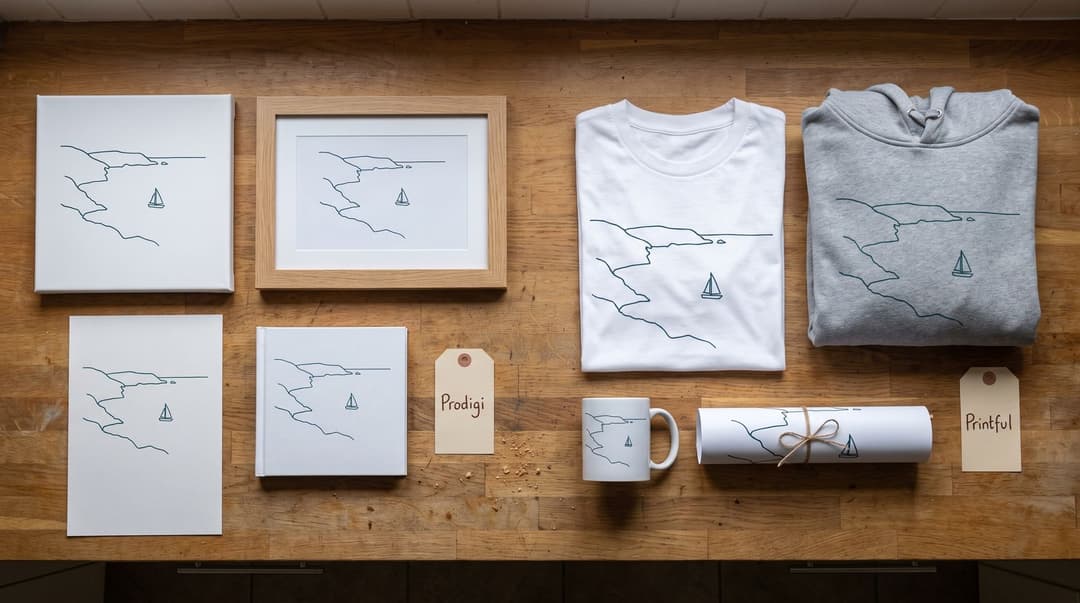
For international sellers, the depth of a product catalog is less important than its regional availability. A platform may list 900 items, but if the product you want to sell to your UK customers can only be fulfilled from the United States, it’s not a practical choice due to high shipping costs and potential customs delays.
Prodigi’s catalog is particularly strong in paper products, wall art, and photo gifts. Their distributed network includes many specialized labs that excel at producing high-quality giclée prints, canvases, and framed art. This makes them a compelling option for artists and photographers who want to leverage local expertise for these specific product categories. The availability of a particular item depends on which partners in their network stock it, so a phone case might be available from a partner in the UK but not one in Germany.
Printful offers a deep and consistently available catalog, with a focus on apparel, accessories, and home & living products. Core products like the Bella + Canvas 3001 t-shirt or Gildan 18000 sweatshirt are stocked and fulfilled across their main facilities in North America and Europe. This means you can sell the exact same item to customers on both continents with confidence in its availability and quality. Printful also standardizes its premium branding options, like inside neck labels and custom pack-ins, making them available globally. This is a significant advantage for building a cohesive international brand experience.
To use a concrete example: ordering a standard 12×18 inch canvas print for delivery to Germany is fulfilled locally by both platforms. However, for a niche item like an all-over-print hoodie, Printful will fulfill it from its own facility in Latvia or Spain. Prodigi’s network might route a similar order to a partner in the Netherlands or the UK, which could result in a different base cost, fulfillment time, and final print feel.
Pricing, Profit Margins & Cross-Border Fees

When selling internationally, the product base cost is only one part of the equation. The total landed cost, which includes the product, shipping, and any value-added tax (VAT) or customs duties, is what the customer ultimately pays and what determines your true profit margin. How a POD platform handles these cross-border fees is a critical point of comparison.
Printful has invested significantly in simplifying international tax compliance for its sellers. According to Printful’s approach to taxes, the platform automatically calculates, collects, and remits VAT and Goods and Services Tax (GST) for orders destined for the UK, EU, Australia, and other regions, as of October 2026. This is a major operational benefit, as it removes the burden from the seller of having to register for and manage taxes in multiple countries. The tax is added to the order total at checkout, providing transparency for the seller and ensuring the customer does not face unexpected charges upon delivery.
Prodigi’s model generally places more responsibility on the seller for managing international taxes. As detailed in Prodigi’s guidance on shipping and taxes, they provide the necessary tools and information, but the seller is typically responsible for their own tax compliance. This approach offers more control and flexibility for larger businesses that may already have their own VAT registrations and prefer to handle remittance themselves. However, for smaller sellers or those new to international e-commerce, this can add a significant layer of administrative complexity. The trade-off is clear: Printful offers automation and simplicity, while Prodigi offers more manual control.
Conclusion: Your Priorities Decide the Winner
In the comparison of Prodigi vs. Printful for international sellers, there is no single winner. The right choice is a direct reflection of your business model, product focus, and priorities. The decision rests on the fundamental trade-off between a broad, distributed network and a controlled, consistent in-house system.
Prodigi is the better choice for sellers whose primary goal is to leverage the largest possible network for localized production, especially those focused on wall art and paper goods. It is ideal for those willing to accept some potential variation in product consistency in exchange for maximum geographic reach.
Printful is the better choice for brand-focused sellers who require high levels of product consistency, standardized branding, and simplified tax management across all markets. It is built for businesses that value quality control and a predictable customer experience above all else.
The most effective way to make a final decision is to conduct your own testing. Order samples of your key products from both platforms and ship them to friends or colleagues in your target international markets. This will give you first-hand evidence of fulfillment times, shipping costs, and the all-important final product quality.
FAQ
Does Printful or Prodigi have better shipping to the UK and EU?
Both platforms offer strong solutions for the UK and EU. Prodigi provides access to a wider network of local print partners, which can sometimes result in faster shipping. Printful's in-house facilities in Europe offer highly consistent product quality and streamlined, automated VAT handling, which is a significant advantage for many sellers.
Can I use both Printful and Prodigi?
Yes. Many businesses use a multi-supplier strategy, routing orders to the platform that offers the best fulfillment location, base cost, or specific product for a given customer's order.
Which platform is cheaper for international orders?
There is no single 'cheaper' platform. The final cost depends on the specific product, destination country, and shipping method chosen. The best approach is to compare the total landed cost, which includes the product base cost, shipping, and any applicable taxes for each order.
Keep reading
- Gooten vs. Printful: A 2026 Comparison for Sellers
Gooten vs Printful: Which is right for your store in 2026? We compare print quality, product pricing, integrations, and fulfillment models to help you decide.
- Is Printful Just for Selling Merch? A Look at All Its Uses
Learn how Printful works for more than just merch. We explore its uses for online sellers, personal one-off orders, and corporate needs to see if it's right for you.
- Printify vs. Spring (Teespring): Which Is Better for Creators?
Choosing between Printify vs Teespring (now Spring)? We compare the supplier and marketplace models on pricing, integrations, and branding to help you decide.