Gooten vs. Printful: A 2026 Comparison for Sellers
Gooten vs Printful: Which is right for your store in 2026? We compare print quality, product pricing, integrations, and fulfillment models to help you decide.
· 8 MIN
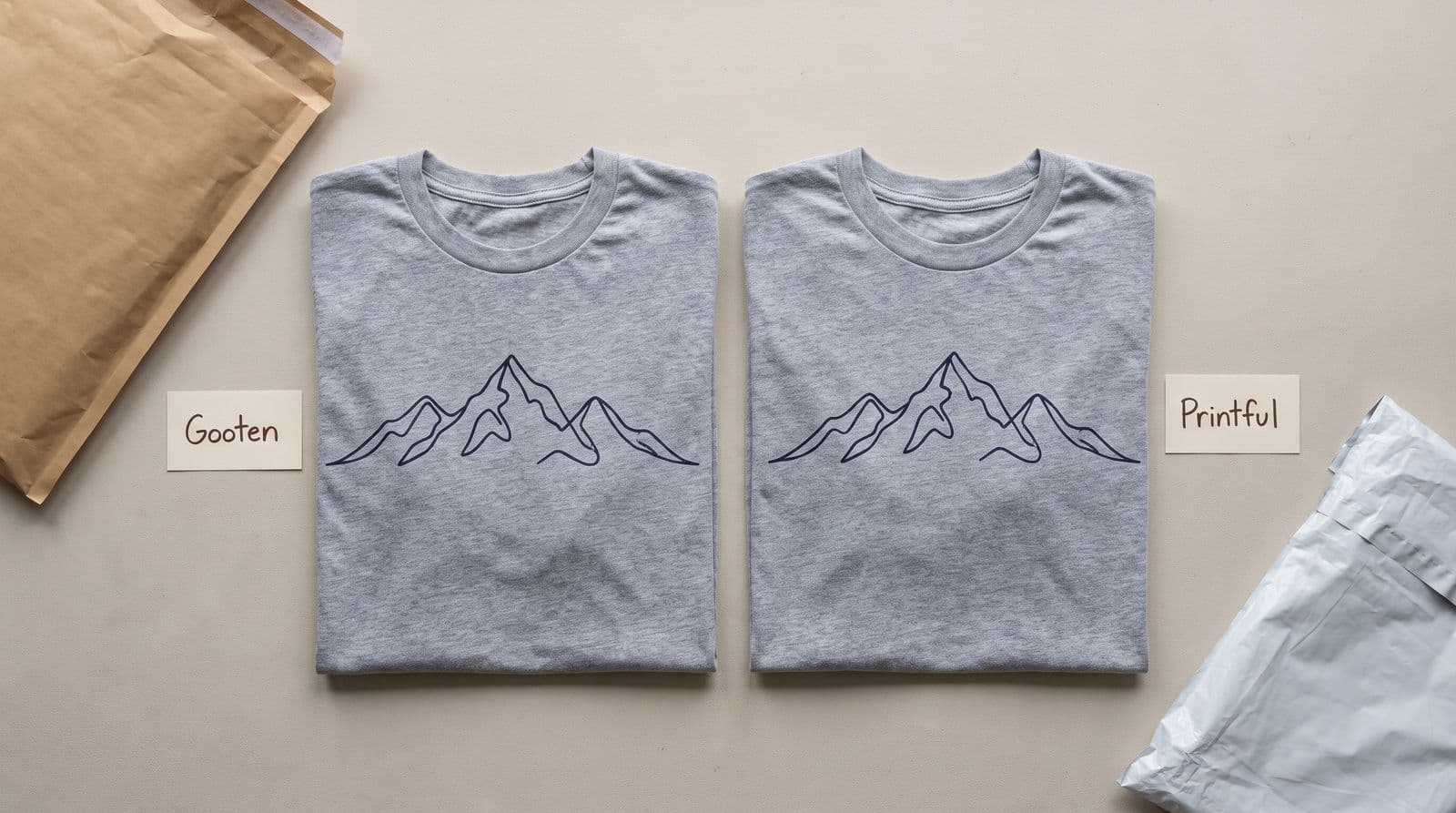
Choosing a print-on-demand partner is a foundational decision for any e-commerce brand. It directly influences product quality, shipping speed, customer satisfaction, and ultimately, your profit margins. Among the leading fulfillment services, Gooten and Printful represent two distinct approaches to the same goal. This comparison is designed to help you decide which model best suits your business in 2026.
Printful operates on a vertically integrated, in-house production model, controlling the entire process from printing to shipping. Gooten, in contrast, is a technology platform that connects sellers to a distributed global network of third-party print providers. While we’ve previously compared Gooten and Printify, the choice between Gooten and Printful presents a different set of trade-offs centered on production models.
This article evaluates Gooten vs. Printful across three key criteria: their production model and its impact on quality, product catalog and pricing, and integrations and ease of use.
At a Glance: Gooten vs. Printful Verdict
| Criterion | Gooten | Printful |
|---|---|---|
| Business Model | Aggregator of third-party print providers | In-house, vertically integrated fulfillment |
| Best For | Unique product catalogs, especially home goods | Consistent quality and premium branding options |
| Key Strength | Expansive and diverse product selection | High reliability in print quality and fulfillment |
| Main Trade-off | Potential for variability between suppliers | A more focused, less niche product catalog |
Verdict
The choice between Gooten and Printful hinges on a single, critical trade-off: product variety versus operational consistency. Gooten provides access to a vast and often unique product catalog by intelligently routing orders to a global network of specialized print partners. This is its core strength, unlocking niche items not available elsewhere. This model, however, introduces potential variability; an order for a t-shirt may go to one supplier, while a subsequent identical order could go to another, leading to subtle differences in print quality, color accuracy, or even packaging. It requires a more hands-on approach to quality control through sample ordering.
Printful offers a more controlled and predictable experience. By owning and operating its fulfillment centers, it ensures that every product meets a consistent quality standard. Fulfillment times are generally stable, and the entire user experience, from the mockup generator to customer support, is managed under one roof. This reliability is ideal for brands that see consistency as a cornerstone of their value proposition. The trade-off is a product catalog that, while extensive in core categories like apparel, is curated and less sprawling than Gooten’s. Your priority, unparalleled selection or unwavering consistency, will guide your verdict.
Printful is best for: Brands prioritizing consistent quality, premium branding options (like custom packaging), and a seamless, all-in-one user experience from design to delivery.
Gooten is best for: Sellers seeking a wider, more unique product catalog (especially in home decor), who want to access niche products, and are comfortable managing the potential variability that comes with a multi-vendor network.
Core Difference: Production Model & Print Quality
Printful: The In-House Model
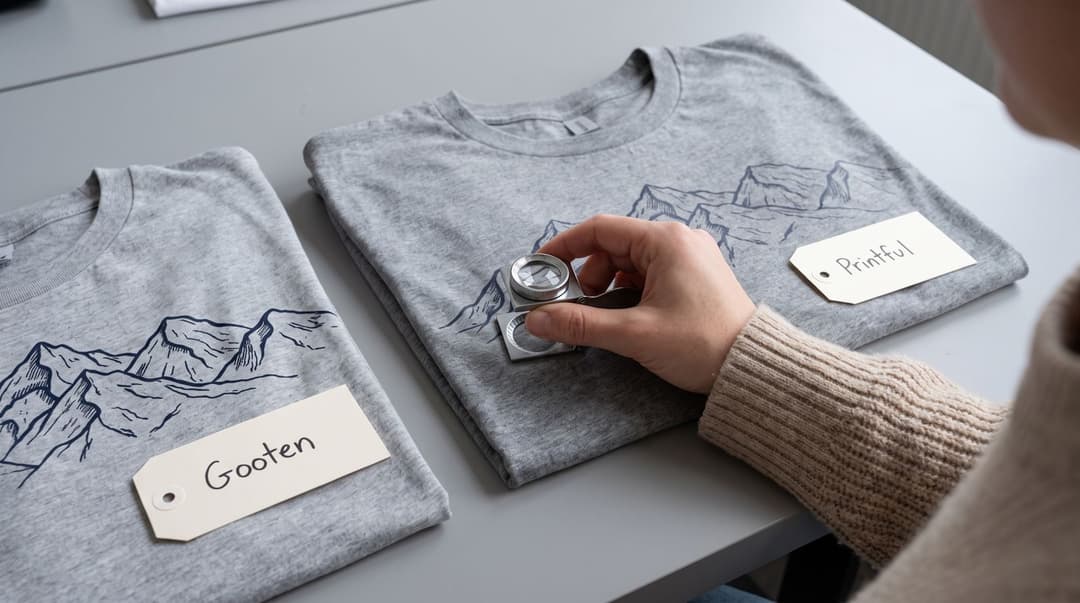
Printful’s approach is built on vertical integration. The company owns and operates its own fulfillment centers across North America and Europe. When you receive an order, it is printed, cut, sewn (for all-over-print products), and packaged by Printful employees using Printful equipment.
The primary advantage of this model is consistency. Because Printful controls the entire production chain, it can enforce strict quality control standards. This translates to reliable print quality, accurate color reproduction, and uniform packaging. A t-shirt ordered today will look and feel the same as the same t-shirt ordered six months from now. This predictability is a significant asset for brand-building, as it ensures customers receive a consistent experience with every purchase.
The trade-off of the in-house model is that product innovation and catalog expansion are tied directly to Printful’s own investment in new machinery and facilities. While the catalog is deep in popular categories, it may not offer the same breadth of niche specialty items found in a distributed network.
Gooten: The Print Network Model
Gooten operates as a technology and logistics platform, not a direct manufacturer. It connects your e-commerce store to a carefully vetted but extensive network of third-party printing companies. When an order comes in, Gooten’s algorithm automatically routes it to the optimal print partner based on factors like product availability, geographic location, and supplier capacity.
The key benefit of this model is product diversity. By partnering with dozens of specialized manufacturers, Gooten can offer a uniquely broad catalog that includes items like acrylic prisms, dog beds, and complex home decor pieces that a single company would find difficult to produce in-house. This gives sellers the opportunity to build a more distinctive brand with hard-to-find products.
The inherent trade-off is a potential for inconsistency. While Gooten vets its partners, the equipment, ink, and processes can vary from one facility to another. This can lead to slight variations in print vibrancy or feel between identical orders fulfilled by different partners. Consequently, ordering samples is especially critical when using Gooten to verify the quality of the specific suppliers you’ll be relying on and to ensure your final product aligns with your brand’s standards.
Product Catalog and Pricing Compared
Catalog Depth & Variety
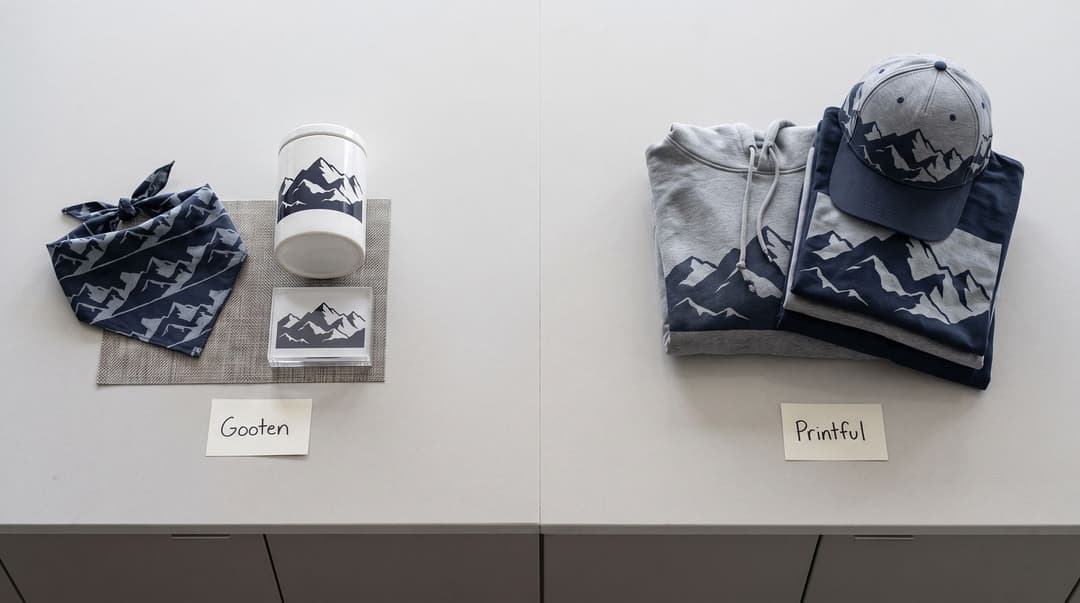
The differences in production models are directly reflected in the product catalogs. Printful’s full product catalog shows a deep and well-curated selection, with a clear strength in apparel. It offers dozens of t-shirt, hoodie, and sweatshirt models from popular brands like Bella + Canvas, Gildan, and Champion, alongside a wide range of hats, leggings, and accessories. Printful also has a growing catalog of home and living items, such as mugs, posters, and blankets, but its core focus remains on wearable goods.
Gooten’s product catalog, by contrast, is defined by its breadth and novelty. While it also offers standard apparel, its main appeal lies in its extensive list of unique products you won’t easily find elsewhere. Categories like home decor (canisters, placemats, acrylic blocks), pet products (bandanas, beds), and kitchen accessories give sellers an edge in creating a niche store. This variety is a direct result of its network model, which taps into the specialized capabilities of many different manufacturers.
Pricing & Profit Margin Simulation
To understand the financial implications, let’s compare the base costs of a few common products. Base cost is what the platform charges you for the product and printing; your profit is the retail price minus this base cost and shipping.
The illustrative table below uses a retail price of $30.00 for a t-shirt and $25.00 for a mug to calculate the potential profit margin. Figures are taken from each platform’s own product pages in October 2026 and will change; shipping is each platform’s lowest standard US rate for one item.
| Product | Gooten base cost* | Printful base cost | Gooten US shipping | Printful US shipping | Est. margin (Gooten)* | Est. margin (Printful) |
|---|---|---|---|---|---|---|
| Bella + Canvas 3001 (retail $30) | From $8.65 | $11.92 | From $4.95 | From $4.95 | Up to $16.40 | $13.13 |
| 11 oz white mug (retail $25) | From $3.41 | $6.07 | From $5.49 | From $6.69 | Up to $16.10 | $12.24 |
*Gooten publishes only its volume-tier floor (“volume pricing starts at”) on its public product pages; the single-unit base cost a new seller pays is higher and visible after login. Treat the Gooten margin as a ceiling, not a quote. Printful figures are single-unit prices from its catalog, size XS for the tee.
Gooten’s base costs are often lower on a per-item basis. However, a key consideration is shipping. If a customer orders two different items from your store that are fulfilled by two different Gooten partners, they may be shipped separately, potentially increasing total shipping costs and impacting your profit margin. Printful’s orders are fulfilled from a single location, simplifying shipping calculations.
For high-volume sellers, it’s also worth noting that Gooten offers a VIM (Very Important Merchant) program, which provides discounts on products and shipping for businesses that meet certain order volume thresholds. This can make its pricing more competitive at scale.
Integrations and Ease of Use

A print-on-demand service must fit seamlessly into your existing e-commerce workflow. Both Printful and Gooten offer integrations with major platforms, but their scope differs.
Printful offers a wider array of native, one-click integrations. As detailed in Printful’s list of integrations (as of October 2026), it connects directly with over 20 platforms, including Shopify, Etsy, WooCommerce, Wix, Squarespace, and BigCommerce. This broad support makes setup straightforward for most sellers.
Gooten focuses on the most popular platforms. Gooten’s current integrations (as of October 2026) include direct connections for Shopify, BigCommerce, WooCommerce, and Etsy, along with a robust API for custom solutions. While the list of native integrations is shorter, it covers the largest segments of the e-commerce market.
Regarding user experience, Printful’s platform is often cited for its polish and feature-rich design tools. Its mockup generator is powerful, offering a wide range of high-quality images and customization options that help create professional-looking product listings. Gooten’s interface is functional and effective, but the overall user experience is geared more towards efficient order management than creative design tools.
Conclusion
Ultimately, the Gooten vs. Printful decision is not about finding a universal winner, but about aligning a platform’s strengths with your business priorities. The choice comes down to the core trade-off between an expansive, diverse catalog and unwavering operational consistency.
If your brand strategy relies on offering unique, hard-to-find products, particularly in categories like home goods and pet accessories, Gooten’s vast supplier network is a compelling advantage. You gain access to a product range that is difficult to match.
If, however, your priority is building a brand on a foundation of predictable quality, consistent fulfillment, and powerful branding tools, Printful’s in-house model provides the control and reliability needed to deliver a uniform customer experience every time. Whichever way you lean, order the same design from both catalogs before committing; the sample in your hands will settle the question faster than any comparison can.
FAQ
Is Gooten cheaper than Printful?
Gooten's base costs for some individual items can be lower than Printful's. However, the final cost-effectiveness depends on shipping, as orders containing items from multiple Gooten suppliers may incur separate shipping fees, potentially increasing the total order cost.
Which has better print quality, Printful or Gooten?
Printful generally offers more consistent print quality because it controls the entire production process in its own facilities. Gooten's quality can be excellent but may vary, as it depends on which of their third-party partners fulfills a specific order.
Can I use both Gooten and Printful?
Yes, it is possible for a store to use both services simultaneously to take advantage of each platform's unique product offerings. This approach, however, adds complexity to store management, as you will need to track orders and manage customer service across two separate systems.
Keep reading
- Prodigi vs. Printful: Which Is Better for International Sellers?
Prodigi vs Printful (2026): A detailed comparison for international sellers. We analyze fulfillment networks, cross-border fees, and product quality to help you choose.
- Print-on-Demand for Books & Journals: A 2026 Comparison
Choosing a platform for print-on-demand for books? We compare Amazon KDP, Lulu, and IngramSpark on quality, distribution, and cost to help you decide in 2026.
- Best Print-on-Demand for Stickers: A 2026 Comparison
A detailed comparison of the best print on demand for stickers. We review Printful, Printify, and more on quality, cost, and variety to help you choose.