Gooten vs Printify: Which Is Better?
Weighing Gooten vs Printify? See how curated automation stacks up against an open marketplace on quality, cost, and catalog before you pick a partner.
· UPDATED · 8 MIN
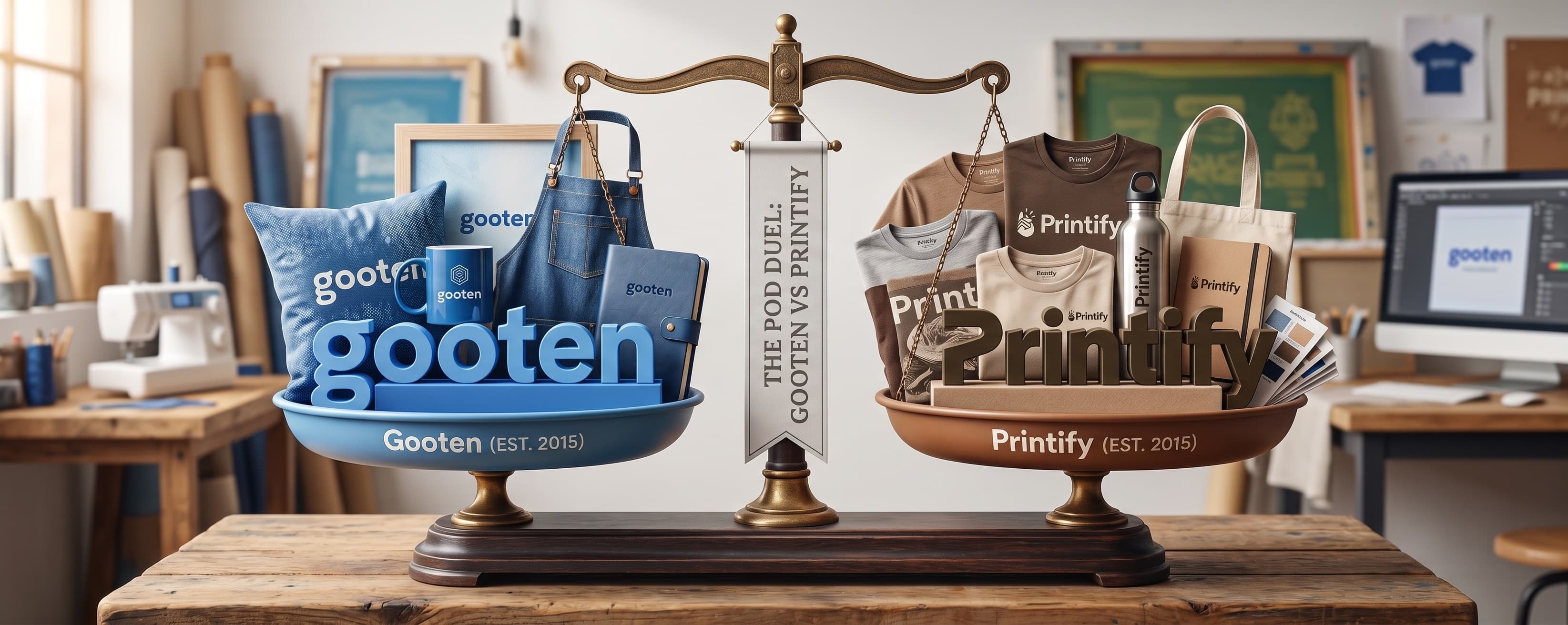
Choosing the right print-on-demand partner is one of the most critical decisions for an e-commerce business. Every online merchant eventually faces a clear strategic choice: do you build your store on Gooten's carefully managed fulfillment network, or do you choose Printify's sprawling open marketplace?
In this comprehensive Gooten vs printify comparison, we will analyze both platforms to see which model serves your business goals. As a prominent gooten competitor, Printify provides a vastly different approach to product sourcing and quality control. This article cuts through standard marketing claims to deliver an evidence-based verdict based on print quality, product catalogs, and real-world costs, helping you make the most informed choice for your e-commerce store.
Quick Comparison: Gooten vs Printify at a Glance
The table below summarizes the core operational and financial differences between these two platforms. In the printify vs gooten matchup, the choice comes down to a curated, automated model versus a sprawling, seller-controlled system. This single distinction drives almost every difference in pricing, integration limits, and shipping speed.
| Attribute | Gooten | Printify |
|---|---|---|
| Fulfillment Model | Curated network with automated order routing | Open marketplace of independent print providers |
| Pricing Structure | Free; pay base cost per item (VIM loyalty discounts available) | Free tier; Premium subscription ($39/month, or $24.99/month billed annually) for product discounts |
| Product Catalog | Approximately 150 high-quality, curated items | Over 900 distinct product types with multi-supplier duplicates |
| Best For | Scaling Shopify brands wanting consistent quality and automation | Etsy beginners and design testers wanting maximum direct margins |
| Key Weakness | Smaller overall catalog and fewer direct integrations | Variable print quality across different suppliers |
| Integrations | Shopify, Etsy, WooCommerce, BigCommerce, API | Shopify, Etsy, WooCommerce, eBay, Wix, Squarespace, Walmart, API |
To understand this dynamic, you must look at how each platform handles order execution. Gooten prioritizes a highly curated, automated routing system, whereas Printify operates as an open portal where you manage individual relationships with print facilities.
The industry landscape has shifted with major corporate movements. Taylor Corporation acquired Gooten to bolster its print-on-demand and logistics capabilities. Meanwhile, Printify and Printful announced their merger under the parent brand Fyul, creating a combined network that serves millions of sellers. Despite these high-level corporate changes, both platforms continue to run as separate, distinct front-end tools for online merchants.
Product Catalog & Variety: Who Offers More Choice?
According to official listings, the Printify catalog spans over 900 distinct products. However, this count can be misleading because Printify counts every single supplier variation as a unique SKU. For instance, a standard unisex t-shirt like the Bella+Canvas 3001 is listed multiple times because it is fulfilled by several different print providers. This structure gives you immense flexibility in choosing where your garments are printed, but it inflates the apparent variety of the catalog.
In contrast, Gooten's curated catalog features around 150 high-quality products. Gooten does not duplicate listings for different suppliers. Instead, they display a single product listing and manage the backend routing automatically, keeping your inventory management straightforward.
When comparing unique offerings, Gooten excels in home goods and pet accessories. Their pet collection is exceptionally comprehensive, featuring custom dog beds in three sizes, ceramic pet bowls in two sizes, pet bandanas, and placemats. For kitchen and dining brands, Gooten offers tailored textile collections including tablecloths, table runners, woven placemats, and cloth napkins.
Printify dominates in specialty apparel and trend-driven novelty items. On Printify, you can source unique items like eco-friendly sportswear, custom holiday wrapping paper, and high-demand blanks from premium brands like Comfort Colors.
The user experience of the mockup generators also differs. Gooten's mockup generator is direct and functional, but it offers relatively basic flat-lay previews. Printify's tool provides more advanced 3D previews and lifestyle mockups, allowing you to see how designs drape over garments in real-world environments.
For a niche Etsy shop focusing on coordinated home decor or pet lines, Gooten's targeted depth is ideal. For a rapidly iterating apparel brand on Shopify, Printify's sheer volume of clothing styles and color variants provides a distinct competitive edge.
Print Quality & Fulfillment: Consistency vs. Control
The fundamental difference between these platforms lies in their operational philosophy. Gooten operates a curated partner network. When an order is placed, Gooten's proprietary routing algorithm automatically directs it to the optimal manufacturing partner based on factors like price, delivery destination, and current production capacity. This hands-off approach ensures that you do not have to manually redirect orders if a specific print shop runs out of stock.
Printify uses an open marketplace model. You choose the specific print provider for each product in your store based on their location, pricing, and historic performance ratings. If your primary supplier runs out of stock, you must manually switch the product to a different provider or set up automated routing rules within Printify's system.
This structural difference directly impacts print quality and consistency. With Gooten, the quality control is managed systematically by Gooten's team, who regularly vet their manufacturing partners. In physical sample testing, Gooten's prints show impressive color accuracy and a highly durable finish, particularly on complex home textiles.
Printify's quality depends entirely on the specific provider you select. Sourcing a garment from a highly-rated provider like Monster Digital often yields exceptional print vibrancy and soft-hand prints, whereas choosing a cheaper, lower-rated supplier can result in muted colors or alignment issues.
While Gooten's curated network offers more consistency than Printify's open marketplace, sellers prioritizing guaranteed quality control might consider a fully integrated in-house production model like Printful's, where every item is produced and shipped from their own facilities. This vertically integrated alternative eliminates the unpredictability of third-party networks entirely, though often at a slightly higher base price.
When it comes to shipping speeds, both platforms perform competitively but exhibit different patterns. According to Gooten's shipping guidelines, most items are produced and shipped within three to four business days, though certain specialty home goods can take up to five days. Printify's fulfillment times vary by supplier, generally ranging from two to seven business days.
During peak holiday seasons, Gooten's automated routing helps mitigate delays by shifting volume away from overloaded facilities, whereas Printify sellers must actively monitor supplier performance and manually route orders if a chosen provider falls behind.
Tip
Whichever platform you choose, order a physical sample of any product before you list it. On Printify especially, sample the exact provider you plan to use. Switching providers can change color accuracy and garment feel on an identical design.
Pricing & Profitability: Which Platform Is Cheaper?
To protect your profit margins, you must understand how both platforms structure their pricing. Gooten is completely free to use, requiring no monthly subscription fees. You only pay Gooten the base cost of the product and shipping when a customer makes a purchase on your store. Gooten's base prices are highly competitive, especially for home decor and wall art.
Printify operates on a freemium model. Their Free plan offers standard base pricing, while the Printify Premium plan costs $39 per month (or $24.99 per month when billed annually) (checked October 2026). Premium unlocks up to a 20% discount on almost all catalog products, which significantly lowers your per-unit costs and increases your margins on popular apparel items.
The mathematical break-even point for Printify Premium is highly predictable. If you save an average of $2 to $3 per custom t-shirt or hoodie, you only need to sell 10 to 15 items per month to cover the $39 monthly fee (less on annual billing; checked October 2026). Any sales beyond this threshold directly increase your store's net profitability. If your monthly volume is below 10 orders, staying on Printify's Free plan or using Gooten is the more cost-effective approach.
Here is a direct comparison of estimated base costs for a standard Bella+Canvas 3001 t-shirt:
- Gooten (Standard Tier): ~$8.50 to $9.50 (depending on routing)
- Printify (Free Plan): ~$9.00 to $10.50 (depending on chosen provider)
- Printify (Premium Plan): ~$7.00 to $8.20 (depending on chosen provider)
Note: Base prices do not include shipping, which varies by destination. Estimates come from the Gooten and Printify catalogs, September 2026.
Shipping costs are calculated dynamically by both platforms. Gooten uses a flat-rate shipping model for many products, which simplifies your pricing setup, while Printify's shipping rates are set individually by each print provider. This means that if a customer orders two different products fulfilled by two different Printify suppliers, you will pay separate shipping fees for each item, which can quickly erode your margins unless you pass those costs on to the buyer.
For scaling merchants, Gooten offers a dedicated loyalty system called the Very Important Merchant (VIM) program. This program is structured into four tiers based on your annual spending. As you scale your sales volume, the VIM program grants you access to discounted product pricing, dedicated customer service representatives, and early access to new product rollouts. This makes Gooten highly competitive for established merchants who process hundreds of orders monthly.
The Verdict: Who Should Use Gooten, and Who Should Use Printify?
Choosing between these platforms depends on your operational priorities and catalog requirements. Neither tool is universally better than Gooten or Printify; instead, each serves a distinct business structure.

Use Printify if:
- You want maximum control over suppliers: You want the power to hand-pick your printing partners based on location, pricing, and historic performance ratings.
- You sell trendy or niche apparel: You want access to specialty brands like Comfort Colors and a vast array of unique clothing styles.
- You want to optimize margins early: You are willing to pay a monthly premium fee to secure the lowest possible unit costs once you pass 15 sales per month.

Use Gooten if:
- You prioritize automated operations: You want a hands-off system that handles supplier routing automatically so you can focus entirely on marketing.
- Your niche is home decor or pet products: You want to offer high-quality matching sets like dog beds, blankets, and custom placemats with consistent color matching.
- You are a high-volume seller: You want to utilize Gooten's VIM program to secure volume discounts and dedicated partner support.
Best for specific profiles:
- Best for the Beginner Etsy Seller: Printify. The free plan, coupled with the straightforward product publishing tool, allows beginners to test designs with minimal upfront risk and complete control over specific shipping origins.
- Best for the Scaling Shopify Brand: Gooten. The automated backend routing and curated partner network minimize customer service issues caused by inconsistent garment prints or stock shortages.
- Best for the Artist Selling Niche Items: Printify for unique novelty accessories and specialty apparel lines; Gooten for premium canvas prints, home textiles, and custom pet gifts.
Conclusion: Gooten vs Printify
The core trade-off when deciding between Gooten vs Printify comes down to consistency versus direct control. Gooten offers a streamlined, hands-off fulfillment network that delivers reliable results, making it an exceptional long-term partner for merchants scaling their brands. Printify provides a flexible, open marketplace with the industry's largest catalog and highly competitive pricing via its Premium subscription, which is ideal for testing designs and maximizing immediate margins. By aligning your chosen platform's operational model with your business goals, you can build a stable, profitable print-on-demand store that stands the test of time.
FAQ
Can I use both Gooten and Printify on the same store?
Yes, you can integrate both Gooten and Printify with your Shopify, Etsy, or WooCommerce store simultaneously. Many sellers use Gooten for high-quality home goods and pet accessories, while sourcing their main apparel lines from Printify.
Which platform has faster shipping times?
Printify's shipping times are highly dependent on the individual supplier you select, often ranging from 2 to 7 days. Gooten's shipping is highly consistent due to its automated routing, typically delivering orders within 3 to 5 business days.
How does Gooten's automated routing work?
When a customer places an order, Gooten's system analyzes the delivery address and automatically routes the order to the vetted print partner closest to the buyer that has the item in stock. This reduces transit times and shipping costs automatically.
Is Printify Premium worth the monthly cost?
Printify Premium is highly cost-effective if you process more than 15 orders per month. The subscription fee is offset by product discounts of up to 20%, which directly improves your profit margins.
Keep reading
- Printify vs. Gelato: Which Is Better for Your Store in 2026?
Choosing between Printify vs Gelato? Our 2026 review compares pricing, product catalogs, shipping, and fulfillment models to help you find the best fit for your store.
- Printify vs. Spring (Teespring): Which Is Better for Creators?
Choosing between Printify vs Teespring (now Spring)? We compare the supplier and marketplace models on pricing, integrations, and branding to help you decide.
- POD Shipping Times: Printful vs Printify vs Gelato in 2026
Comparing print on demand shipping times for 2026? We analyze fulfillment and transit for Printful, Printify, and Gelato to help you choose the right POD platform for your store.