Printify vs. Gelato: Which Is Better for Your Store in 2026?
Choosing between Printify vs Gelato? Our 2026 review compares pricing, product catalogs, shipping, and fulfillment models to help you find the best fit for your store.
· 8 MIN
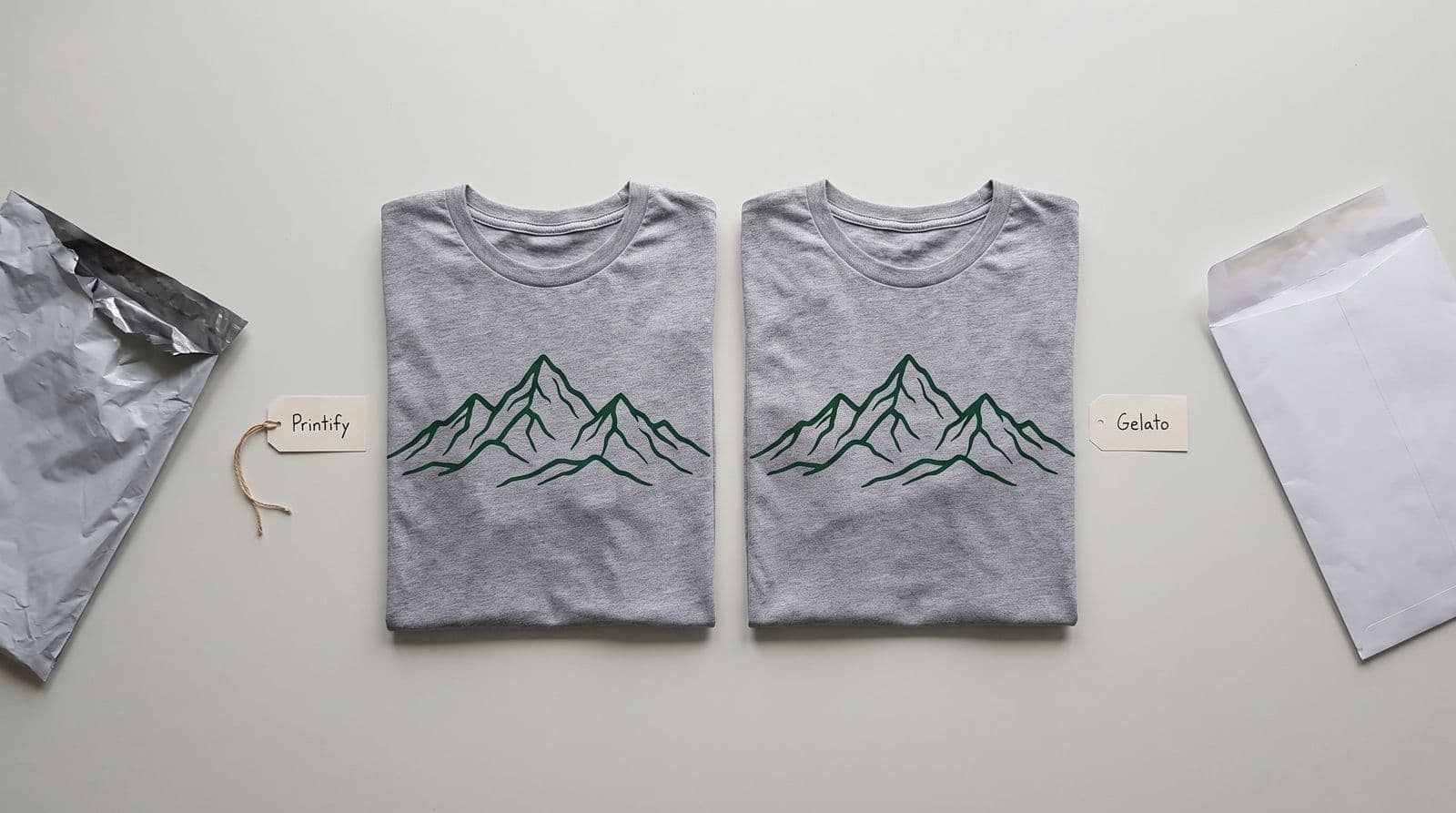
Choosing a print-on-demand (POD) partner is a foundational decision for an e-commerce store. It affects everything from your product catalog and print quality to your shipping times and profit margins. Two of the most prominent platforms, Printify and Gelato, represent two distinct approaches to the POD model. Printify operates as an open marketplace, connecting you with a vast network of individual print providers. Gelato, in contrast, offers a curated and standardized global network of production hubs.
This article provides a detailed comparison of Printify vs. Gelato to help you determine which platform aligns best with your business goals. We will analyze each service against consistent criteria, including pricing, product selection, quality control, and fulfillment logistics.
Printify vs. Gelato: The Key Differences at a Glance
The fundamental difference between the two platforms is a trade-off between choice and consistency. Printify gives you maximum choice over suppliers, products, and pricing, but this requires more hands-on management to ensure quality. Gelato simplifies the process with a standardized global network, offering consistency at the cost of a more limited catalog and less direct control over production partners.
| Feature | Printify | Gelato |
|---|---|---|
| Business Model | Open marketplace connecting sellers to a network of third-party print providers. | Curated global network of standardized production partners. |
| Best For | Sellers prioritizing catalog breadth, cost optimization, and direct control over suppliers. | Sellers with a global audience who prioritize consistent quality and fast international shipping. |
| Pricing | Free plan available. Paid Premium plan offers product discounts of up to 20%. | Free plan available. Paid Gelato+ plan offers product discounts of up to 33% and premium features; Platinum tier at custom pricing. |
| Product Catalog Size | 2,000+ products from a wide range of suppliers. | 300+ products (per Gelato’s own figure), with a focus on paper goods, wall art, and core apparel. |
| Fulfillment Network | Dependent on the location of the specific print provider chosen by the seller, or routed automatically with Printify Choice. | 250+ production facilities in 32 countries, with automated order routing. |
Printify is the better fit for sellers who want to fine-tune their product sourcing and are prepared to vet individual suppliers to find the best value for money. Gelato is the stronger fit for brands that serve a geographically diverse customer base and value the simplicity of a system that automatically handles production logistics.
Pricing and Profitability: Which Platform Offers Better Value?
Both Printify and Gelato operate on a freemium model, allowing you to start selling with no upfront monthly fees. However, their paid subscription plans offer different types of value, making one potentially more profitable than the other depending on your sales volume.
Printify offers a free plan and a Premium plan. The free plan gives you access to the entire platform, while the Premium plan (from $39 a month, or from $24.99 a month billed yearly) provides a discount of up to 20% on all products and up to 33% on newly added ones, per Printify’s pricing page (checked October 2026). This structure directly impacts your product base cost, making it a clear choice for high-volume sellers. For sellers with more than a handful of orders per month, the subscription fee is often offset by the accumulated product discounts, directly increasing their print on demand profit margins.
Gelato also has a free plan, along with a paid Gelato+ tier ($29.99 a month, or $19.99 a month billed annually, per Gelato’s subscription plans page, checked October 2026) and a Platinum tier with custom pricing for high-volume sellers. Like Printify, Gelato+’s core benefit is a product discount, up to 33% on base costs, alongside premium mockups, the Personalization Studio, AI listing tools, and branded packaging options, per Gelato’s subscription plans page (as of October 2026). The discount does not apply to shipping; Gelato’s shipping advantage comes from where it produces, not from the plan.
To illustrate, consider a common product like the Bella + Canvas 3001 t-shirt. On Printify’s free plan, a seller might find a provider with a base cost of around $10.50 to $11. With Premium, that could drop to around $8.50. At roughly $2 saved per shirt, a seller moving a dozen or more a month covers the Premium fee. On Gelato, the same shirt listed at €10.22 (about $11.75) for UK delivery in October 2026, dropping to €8.18 with Gelato+, a saving of a little over $2 per shirt that breaks even at a similar volume. Both plans, then, reward the same thing, consistent sales; the better value depends on which platform’s catalog, providers, and shipping routes fit the markets you sell into.
Product Catalog and Quality Control

Your product catalog is central to your brand, and here the platforms diverge significantly. Printify’s main strength is its sheer variety, boasting a catalog of over 2,000 products. This breadth is a direct result of its marketplace model, which aggregates the offerings of dozens of different suppliers. You can find everything from standard apparel and mugs to niche items like custom pet beds and Bluetooth speakers. The trade-off is that quality control is your responsibility. Since you are choosing from Printify’s network of print providers, you must research their ratings, order samples, and monitor consistency yourself. Print quality can vary widely from one supplier to another. Printify Choice, which assigns a provider automatically on price, quality, and proximity, removes the vetting work but also the visibility into who printed a given order.
Gelato takes a more curated approach. Its catalog is smaller, at just over 300 products by Gelato’s own count, but it is highly focused. The platform is particularly strong in paper products, wall art, photo books, and calendars, alongside a solid selection of core apparel and accessories, recently expanded with brands such as Lane Seven, Allmade, and SOL’S. Because Gelato manages its production network to meet a single quality standard, the results are more predictable in principle; in practice, because different partners print in different countries, seller reviews report some variation in print and packaging, and occasional delays. When a customer in Spain orders a poster, they should receive a product of the same quality as a customer in Japan, and ordering samples to each market is how you confirm it. This consistency is Gelato’s key selling point, but it comes at the expense of the vast selection found on Printify.
Branding options, such as white label packaging and custom neck labels, are available on both platforms. Printify offers these on a per-provider basis, with some suppliers offering more customization than others. Gelato offers standardized branding options across its network, though inserts and labels require a paid plan and it does not offer neck labels. Both platforms offer robust tools for creating product mockups and can seamlessly integrate with e-commerce platforms like Shopify, Etsy, and WooCommerce, ensuring a smooth workflow from design to publication. Gelato, for example, lists all the ways it integrates with your e-commerce platform in its documentation.
Fulfillment and Shipping: Global Reach vs. Provider Choice

The most significant operational difference between Printify and Gelato lies in their fulfillment and shipping logistics. This is where Gelato’s model offers a distinct advantage for sellers with an international customer base.
The Gelato print on demand network is built around localized production. When an order is placed, Gelato’s software automatically routes it to the production facility closest to the end customer. With over 250 production facilities in 32 countries, this system can dramatically reduce fulfillment time and shipping costs, while also lowering the carbon footprint of each order. For a seller in the US with customers in Europe and Australia, this is a powerful feature that ensures a better and more consistent delivery experience worldwide, with the caveat that Gelato’s quoted delivery times are estimates, not guarantees.
Printify’s model is more manual by default. For each product in your store, you select a single print provider. That provider’s location dictates the fulfillment origin for all orders of that product, regardless of the customer’s location. An order from the UK for a product sourced from a US provider will always face transatlantic shipping costs and times. While this can be highly efficient for sellers focused on a single domestic market, allowing them to find the fastest or cheapest provider for that region, it becomes complex and costly when scaling internationally. Managing a global store with Printify often requires creating duplicate product listings with different providers to serve different regions, or switching those products to Printify Choice and accepting that the provider will vary per order.
For a deeper analysis of its global network and production quality, our full Gelato review covers the platform in detail.
The Verdict
Neither platform is universally superior; the right choice is a matter of business priorities. The decision between Printify and Gelato hinges on the trade-off between choice and consistency. Printify excels at providing an expansive product catalog and the tools for sellers to control their costs by choosing from a competitive marketplace of suppliers. Gelato’s strength is its streamlined, automated global fulfillment network that delivers consistent quality and faster local shipping for an international audience.
Printify is the better choice for entrepreneurs who want to control every detail and are willing to manage supplier relationships to maximize their product range and profit margins. Gelato is the stronger option for brands that value simplicity and serve a global audience, where consistent, localized production is a priority.
Whichever you choose, order the same design from both and ship it to the markets you actually sell into; the two platforms’ models produce different results in different countries, and only samples will tell you which wins for yours.
FAQ
Is Gelato cheaper than Printify?
It depends on your sales volume. Base costs on free plans are often comparable, but Printify Premium can offer deeper discounts than Gelato+ for high-volume sellers, making it cheaper on a per-item basis once the subscription is covered.
Which has better print quality, Printify or Gelato?
Quality on Printify varies by the print provider you choose, which requires research and sample orders. Gelato offers more consistent quality across its curated network because it standardizes its production process.
Can I use both Printify and Gelato?
Yes, many sellers use both platforms to take advantage of their respective strengths, such as using Gelato for wall art and international orders, and Printify for specific apparel items from a preferred US-based provider.
Keep reading
- POD Shipping Times: Printful vs Printify vs Gelato in 2026
Comparing print on demand shipping times for 2026? We analyze fulfillment and transit for Printful, Printify, and Gelato to help you choose the right POD platform for your store.
- SPOD vs. Printful: Which is Better for Your Store in 2026?
SPOD vs. Printful: A detailed 2026 comparison of pricing, speed, product range, and branding. See the real difference and find out which POD platform is best for your store.
- Gelato Review 2026: Pricing, Quality & Our Verdict
A complete Gelato print on demand review for 2026. We cover pricing, product quality from our tests, and shipping speeds to help you decide if it's worth it for your store.