POD Shipping Times: Printful vs Printify vs Gelato in 2026
Comparing print on demand shipping times for 2026? We analyze fulfillment and transit for Printful, Printify, and Gelato to help you choose the right POD platform for your store.
· 8 MIN
“Where is my order?” is one of the most common questions an e-commerce seller receives. The answer often lies in misunderstood shipping timelines. For print-on-demand businesses, where products are created and shipped only after a sale, managing customer expectations about delivery is paramount. This article aims to clarify how print on demand shipping times are calculated and provide a direct comparison of three leading platforms: Printful, Printify, and Gelato.
The right choice is not about finding one universally “fastest” option, as no such thing exists. Instead, it involves understanding the trade-offs of each platform’s model and selecting the one that best aligns with your products, customer locations, and business priorities. This is especially critical during Q4, so be sure to consult the annual POD holiday shipping deadlines. Our comparison is based on three core criteria: fulfillment speed, the structure of the shipping network, and how performance varies by product and region.
The Two Clocks of POD: Understanding Fulfillment vs. Shipping Time
Every print-on-demand delivery operates on two separate clocks, and understanding both is essential for setting accurate customer expectations. The total time from when a customer clicks “buy” to when the package arrives at their door is a combination of these two periods.
Fulfillment Time
This is the first part of the equation. Fulfillment time refers to the period it takes for your POD partner to process the order, print your design onto the blank product, perform quality checks, and package it for shipment. This is the manufacturing phase. On average, this takes between two and seven business days, but several factors can influence the timeline. Product complexity plays a significant role; an all-over-print hoodie or an embroidered cap requires more production steps than a direct-to-garment (DTG) t-shirt and will typically have a longer fulfillment time. High order volumes, such as during the holiday season, or temporary stock issues with a specific blank product can also lead to extensions.
Shipping Time (Transit Time)
Once an order is fulfilled and handed off to a mail carrier like USPS, FedEx, or DHL, the second clock starts. Shipping time, also called transit time, is the duration the package is in the carrier’s network, moving from the fulfillment center to the customer’s address. This timeline depends almost entirely on the shipping method selected (e.g., standard, express, or overnight) and the geographical distance between the production facility and the final destination.
The fundamental formula is simple: Total Delivery Time = Fulfillment Time + Shipping Time. For example, if a t-shirt has a fulfillment time of 3 business days and is sent via a standard shipping method that takes 5 business days, the customer’s total estimated delivery time is 8 business days.
At a Glance: Printful vs. Printify vs. Gelato Shipping Times
Before we analyze the nuances of each platform, here is a high-level overview of their respective approaches to shipping. The key trade-off for sellers is often between the consistency of an in-house model and the flexibility of a distributed network. Printful offers reliability through its own facilities, Printify provides extensive choice through its network of third-party printers, and Gelato leverages its global partner network for optimized international delivery. The “best” option is highly dependent on a seller’s specific product catalog and the geographic concentration of their customer base.
| Platform | Business model | Fulfillment (production) | US standard delivery | EU standard delivery | Best for |
|---|---|---|---|---|---|
| Printful | In-house & partner facilities | 2–5 business days | 3–4 business days after fulfillment | Quoted per order; not published as one range (UK: 3–7 days after fulfillment) | Sellers who prioritize consistency, print quality, and a streamlined workflow. |
| Printify | Print provider network | 2–7 business days (30-day average shown per provider) | 2–5 business days after fulfillment | Varies by provider; check the provider’s stated transit time | Sellers who want maximum product choice and the ability to select providers based on price, location, or speed. |
| Gelato | Global print partner network | Not published separately; included in delivery estimate | 2–4 days total (local production; estimate, not guaranteed) | 2–4 days total (local production); 4–6 days cross-border | Sellers with a significant international customer base, aiming to reduce shipping times and costs. |
Note: The timeframes above are taken from each platform’s own shipping or help pages in October 2026. The platforms report differently: Printful and Printify state fulfillment and transit separately, while Gelato quotes a single delivery estimate that already includes production. All vary by product, destination, and shipping method, and on Printify by print provider. None are guarantees.
These averages provide a useful starting point, but the reality of print on demand shipping times is more complex. The choice of a specific product on Printful, the selection of a particular print provider on Printify, or the customer’s location with Gelato can all significantly alter the final delivery window. The following section provides a more detailed analysis of how each platform’s unique business model impacts its shipping performance and policies.
A Deeper Dive: Platform-Specific Shipping Policies
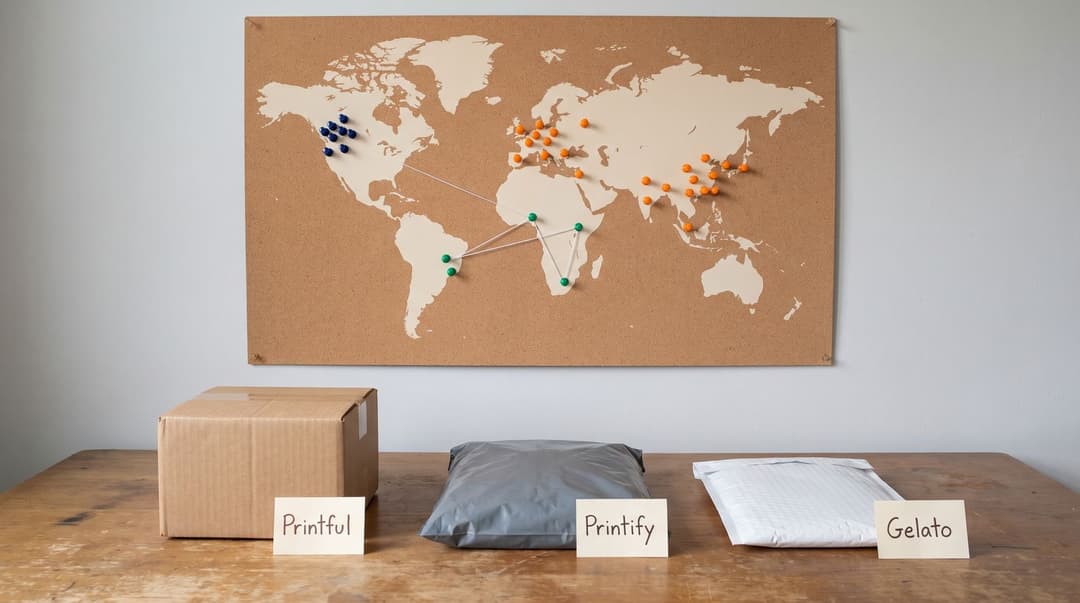
The averages in the table above mask important differences in how each platform manages its operations. A closer look at their fulfillment and shipping policies reveals distinct strengths and weaknesses that can guide your decision.
Printful: Consistency and Reliability
Printful operates a hybrid model, using its own global in-house fulfillment centers alongside a network of trusted partner facilities. This centralized control is its primary strength. Because Printful manages the majority of its production, it can offer highly consistent fulfillment times and print quality. Its published estimates are specific to each product and destination, which is a significant advantage for managing customer expectations.
While not always the lowest-cost or fastest option for every route, the trade-off is predictability. When you add a product to your store, the fulfillment time is clearly stated, and you can be reasonably confident it will be met. This is particularly valuable for sellers building a brand around a premium customer experience. The platform also offers a live shipping rate calculator for your storefront, allowing customers to see accurate costs and options at checkout. For a detailed breakdown of their timelines, you can review Printful’s stated fulfillment and shipping estimates, which are updated regularly (as of October 2026).
Printify: Choice and Flexibility
Printify functions as a marketplace, connecting sellers with a vast, independent network of print providers around the world. This model’s core strength is choice. For almost any product, you can select from multiple providers, filtering them by price, location, and average production time. This allows you to strategically route orders, for example, choosing a provider in the UK for a UK-based customer to reduce shipping time and cost.
However, this flexibility introduces variability. The Printify shipping times and fulfillment quality are entirely dependent on the specific provider you choose. One provider might offer 2-day fulfillment for a t-shirt, while another takes 6 days for the exact same item. This makes due diligence essential. Sellers must research providers, check their performance scores, and always order samples to verify quality before committing to one. Printify’s platform provides tools to help with this, but the responsibility ultimately rests with the store owner.
The key trade-off is accepting more management overhead in exchange for greater control over your supply chain and profit margins. If you would rather not manage providers at all, Printify Choice does it for you: it routes each order to a provider selected on price, quality, and proximity to the customer, at a fixed price, and reassigns out-of-stock items to the next nearest provider. The trade-off is transparency, since the provider used is not disclosed and can differ from one order to the next, which makes it harder to diagnose a quality or shipping problem when one occurs. You can find more details in Printify’s production-times guide.
Gelato: Global Reach and Local Production
Gelato’s model is built for global e-commerce. It operates a distributed network of over 250 production partners in 32 countries. Its primary advantage is its intelligent order routing. When an order comes in, Gelato’s system automatically sends it to the print partner closest to the end customer for production.
This “produce locally, ship domestically” approach has a powerful impact on international shipping. An order for a customer in Germany, for example, will likely be printed in Germany, dramatically reducing transit time, shipping costs, and the risk of customs delays compared to shipping it from the US. This makes Gelato a compelling choice for sellers with a geographically diverse audience. While its US-to-US shipping times are competitive with other platforms, its true strength lies in cross-border sales.
The trade-offs are real, though. Its catalog is more curated than Printify’s, and because production is spread across partners, print and packaging consistency varies by partner; seller reviews are mixed on exactly this point, with recurring complaints about delays, misrouted orders, and support response. Gelato also quotes a single delivery estimate rather than separate fulfillment and transit times, and its own page notes those estimates cannot be guaranteed, so build in a buffer when you publish timelines to customers. For sellers focused on popular items like apparel and wall art with a genuinely international customer base, the logistical efficiency is worth considering. Gelato outlines its approach on its shipping and delivery page, where the quoted delivery time includes production as well as transit.
Which Platform Ships Fastest for You
There is no single winner in the comparison of print on demand shipping times. The best platform is a strategic decision that depends entirely on your business model and customer base. Each service represents a different set of trade-offs, and the right choice aligns with your specific priorities.
Printful stands out for its consistency and reliability, making it an excellent choice for brand-focused sellers who value a predictable customer experience. Printify offers unparalleled flexibility and product selection, ideal for entrepreneurs who are willing to manage provider relationships to optimize for speed or cost. Gelato’s strength is its global network, which makes it worth testing for sellers whose customers are spread across countries, provided you sample from the partners that will serve your main markets and pad the delivery estimates you show customers.
Ultimately, the most critical step is not just choosing a platform, but also communicating delivery timelines clearly and proactively to your customers on your product pages and in order confirmations. This transparency is the foundation of a trustworthy brand.
FAQ
Which POD platform has the fastest shipping?
There is no single "fastest" platform. It depends on the product, destination, and (for Printify) the specific provider chosen. Gelato is often a strong contender for international orders due to its local production network.
How can I reduce shipping times for my POD store?
Choose fulfillment partners located in the same region as your primary customer base, offer expedited shipping options at checkout, and select products with consistently low fulfillment times.
Are the shipping times on POD platforms guaranteed?
No, all stated fulfillment and shipping times are estimates, not guarantees. Delays can occur due to stock issues, print file problems, or carrier backlogs, especially during peak holiday seasons.
Keep reading
- Top POD Sites for Artists: A 2026 Wall Art Review
Finding the best print on demand sites for artists in 2026? We review top platforms for wall art based on print quality, materials, and framing options.
- POD Holiday Shipping Deadlines: When to Stop Taking Orders
Get the latest print on demand holiday shipping deadlines for 2026. Our guide helps you calculate when to stop taking orders to ensure on-time Christmas delivery.
- Printful vs Printify 2026: Which POD Platform Wins?
Comparing Printful vs Printify? See real 2026 profit margins, quality trade-offs, and branding options side by side, then find out which one fits you.