Printify vs. Spring (Teespring): Which Is Better for Creators?
Choosing between Printify vs Teespring (now Spring)? We compare the supplier and marketplace models on pricing, integrations, and branding to help you decide.
· 7 MIN
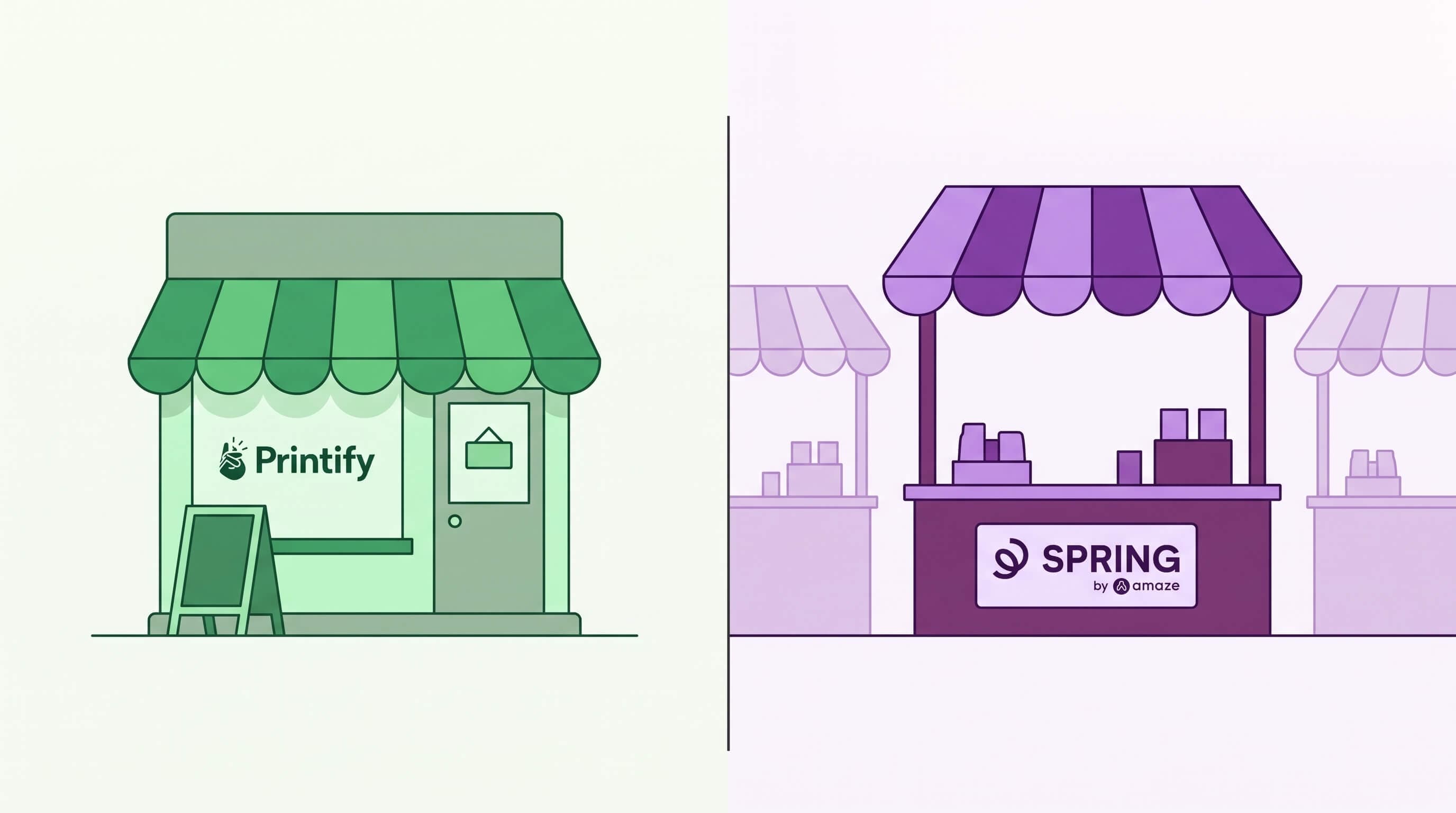
Are you building a standalone e-commerce brand from the ground up, or do you need a fast, simple way to monetize an existing audience? This question is central to choosing between Printify and Spring (formerly Teespring). Both are popular print-on-demand services, but they operate on fundamentally different business models.
The choice between Teespring vs Printify is not about which is universally better, but which is strategically right for your goals. On balance, Printify is the better choice for entrepreneurs seeking long-term brand control, a wider product selection, and the ability to scale an independent business. Spring, on the other hand, is superior for creators who prioritize speed and simplicity, allowing them to sell merchandise directly to their followers with minimal setup.
To help you decide, we will compare them across four key criteria: their core business model, integrations and brand control, pricing structure and profit potential, and their approach to product catalogs and quality.
The Core Difference: POD Supplier vs. Sales Marketplace
Understanding the distinction between Printify and Spring begins with their business models. This is the most significant difference between them and informs every other aspect of the comparison. The choice is between a fulfillment partner that works for your business and a platform that hosts your business.
Printify operates as a print-on-demand supplier and routing platform. It is a B2B (business-to-business) service that connects your e-commerce store to a vast network of print providers. Printify works in the background, handling the printing and shipping of orders that come through your independent storefront, such as one built on Shopify or Etsy. You own the brand, the website, and the customer relationship; Printify is the invisible fulfillment engine.
Spring, by contrast, is a B2C (business-to-consumer) sales marketplace. It provides an all-in-one solution that includes the storefront, payment processing, fulfillment, and basic customer service. Creators upload designs, choose products, and are given a public-facing store URL on the Spring platform. You are a seller on their website, leveraging their infrastructure to reach customers. For those new to the field, this supplier vs. marketplace model is a common framework in the print-on-demand industry.
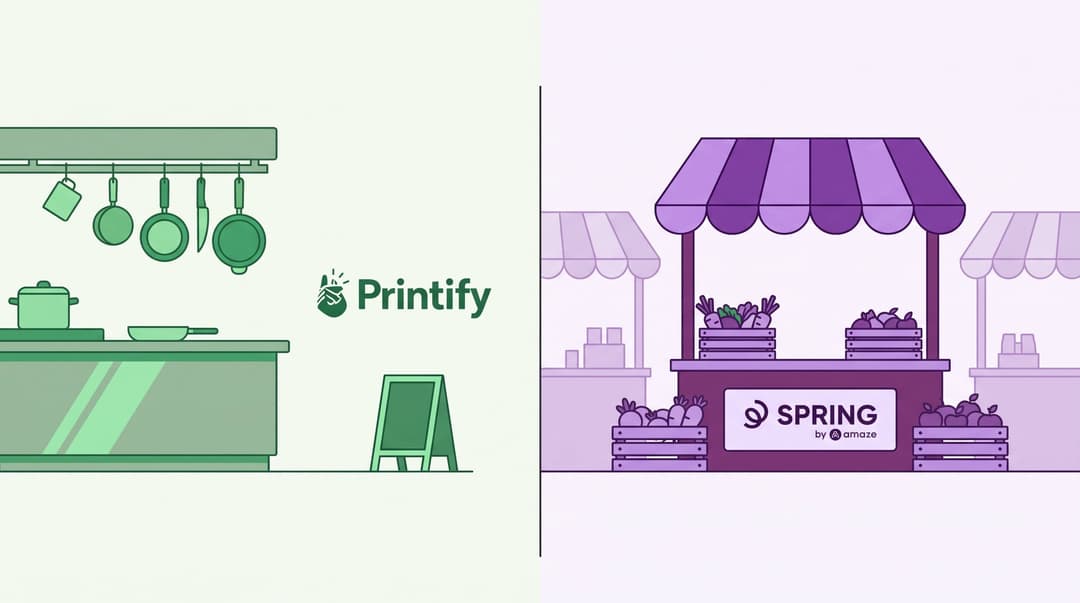
A useful analogy is leasing a commercial kitchen versus selling at a curated food market. With Printify, you lease the kitchen; you have full control over your menu, branding, and pricing, but you are responsible for building the restaurant and attracting customers. With Spring, you are a vendor at a market; you get immediate access to a sales venue and built-in logistics, but you operate within the market's rules and branding, as described in how Spring’s platform operates.
Integrations & Control: Building Your Own Brand vs. Using a Storefront
The difference in business models leads directly to a trade-off between control and convenience. Your choice here depends on whether your primary asset is a brand you want to build or an audience you want to serve.
Printify is built around integrations with dedicated e-commerce platforms. It connects seamlessly with storefronts like Shopify, WooCommerce, Etsy, and Wix. This architecture gives you complete ownership of your business assets. You control your domain name, website design, and all branding elements. Most importantly, you own the customer data, allowing you to run email marketing campaigns and build long-term relationships. This model provides a white-label experience where your brand is the star. Depending on the provider chosen from the network, you can even add custom neck labels or packaging inserts. You can see Printify's list of integrations to see the full range of supported platforms.
Spring's integrations focus on social and content platforms where creators already have an established following. Its most notable integration is with the YouTube Merch Shelf, which allows eligible creators to display their products directly below their videos. There are similar connections for platforms like Twitch and Linktree. This strategy is about monetization, not brand-building. It places your products where your audience already is, reducing friction and simplifying the path to a first sale. However, the storefront and checkout process are always visibly branded as Spring. This is a crucial trade-off: you sacrifice brand control for direct access to your fanbase. Creators should check the official YouTube's Merch Shelf eligibility requirements to see if they can use this feature.
Pricing & Profit: Understanding Your Business Model
How you make money differs significantly between the two platforms. Printify gives you more direct control over your profit margin, while Spring offers a simpler payout system.
With Printify, you are managing the cost of goods sold. When a customer buys from your store, you pay the Printify POD platform for the base cost of the product plus the shipping fee. You set the retail price on your storefront, and your profit is the total revenue minus these costs. This model requires you to manage the flow of money, but it also gives you precise control over pricing strategy and profitability. For example, you could offer free shipping and build that cost into your retail price.
Spring uses a more straightforward profit split model. For each product, Spring has a set base cost. You, the creator, decide the retail price you want to sell it for. When an item sells, Spring keeps the base cost and pays out the difference to you as your profit. There are no platform fees or subscription costs. This is a simple and risk-free way to start, as you never handle fulfillment costs directly. You can find more detail in Spring's payout policies.
Let’s compare using a Bella + Canvas 3001 T-shirt as an example:
- Printify: You set a retail price of $30. The T-shirt has a base cost of $12, and shipping is $5. When a customer pays you $30, you pay Printify $17 ($12 + $5). Your resulting profit is $13.
- Spring: You set the same retail price of $30. Spring’s base cost for the same shirt might be $15. When a customer buys the shirt, Spring handles the transaction and pays you your profit of $15.
In this illustrative example, the Spring payout is higher. However, with Printify, you have the option to switch to a cheaper print provider or subscribe to Printify Premium for a discount on base costs, potentially increasing your profit margin beyond what Spring offers.
Product Catalog & Quality: Network Choice vs. Curated Consistency
When it comes to the products you can sell, the platforms offer a clear trade-off between a vast selection and predictable consistency. Neither approach is inherently superior; the right fit depends on your product strategy and tolerance for variability.
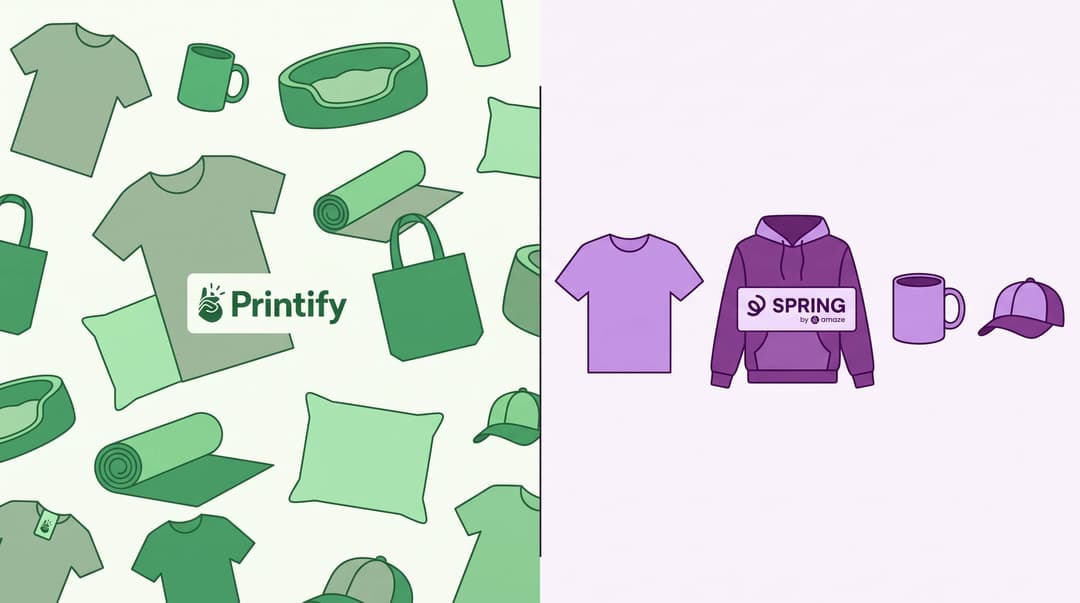
Printify’s key strength is the enormous breadth of its product catalog. Because it aggregates dozens of independent print providers from around the world, you can find everything from standard apparel to niche items like pet beds, yoga mats, and custom-shaped pillows. This variety is a significant advantage for brands looking to offer a unique product line. The trade-off is that print quality, fulfillment time, and even packaging can vary from one provider to another. This makes sample ordering a non-negotiable step for any serious seller using Printify. In our testing, vetting print providers is the single most important factor for success on the platform.
Spring offers a more curated and limited product catalog. It focuses on the most popular merchandise items for creators: T-shirts, hoodies, mugs, and accessories. The advantage of this approach is consistency. Because Spring manages its fulfillment network more directly, you can expect a reliable baseline of quality and predictable shipping times for all your products. You spend less time on logistics and more time on creating designs. The weakness is a lack of choice. If you want to sell a specific or unusual product, you are unlikely to find it on Spring.
Verdict: Which Platform Is Right for You?
Ultimately, the choice between Printify and Spring is a strategic decision about your business goals, not a simple judgment of which platform is better. Each serves a different type of user exceptionally well.
On balance, Printify is the right choice for entrepreneurs and businesses focused on building a long-term, independent brand. It offers the control, product variety, and scalability needed to create a distinct e-commerce destination. The trade-off is a greater degree of responsibility in managing your store and vetting suppliers.
Spring is the ideal solution for content creators, influencers, and artists who want a fast, low-effort way to sell merchandise to an existing audience. It removes nearly all the complexity of e-commerce, allowing you to monetize your fanbase quickly. The trade-off is less brand control and a more limited product catalog. Deciding between Printify or Teespring is about aligning the platform's strengths with your personal objectives.
FAQ
Can I use Printify to sell on the YouTube Merch Shelf?
YouTube's direct integration is with Spring. While not a direct connection, a seller could manually create and link products from a Printify-powered Shopify store to their YouTube channel.
Do I need my own website to use Spring (Teespring)?
No, Spring provides a complete, hosted storefront for you as part of its service, requiring no separate website.
Which is cheaper, Printify or Spring?
Printify's base costs are often lower, offering potential for higher profit margins, but this requires managing a separate e-commerce store. Spring has no upfront costs, making it entirely free to start selling.
Keep reading
- Teespring Alternatives: 4 Top Platforms for Creators in 2026
Searching for reliable Teespring alternatives? We compare 4 top print-on-demand platforms on print quality, profit margins, and integrations to help you choose the best fit for your brand.
- Gooten vs Printify: Which Is Better?
Weighing Gooten vs Printify? See how curated automation stacks up against an open marketplace on quality, cost, and catalog before you pick a partner.
- Printful vs Spring (Teespring): The Definitive Comparison
Comparing Printful vs Spring (Teespring)? See real profit margins, catalog quality, and branding control to find the right fit for your store.