Printful vs Spring (Teespring): The Definitive Comparison
Comparing Printful vs Spring (Teespring)? See real profit margins, catalog quality, and branding control to find the right fit for your store.
· UPDATED · 7 MIN
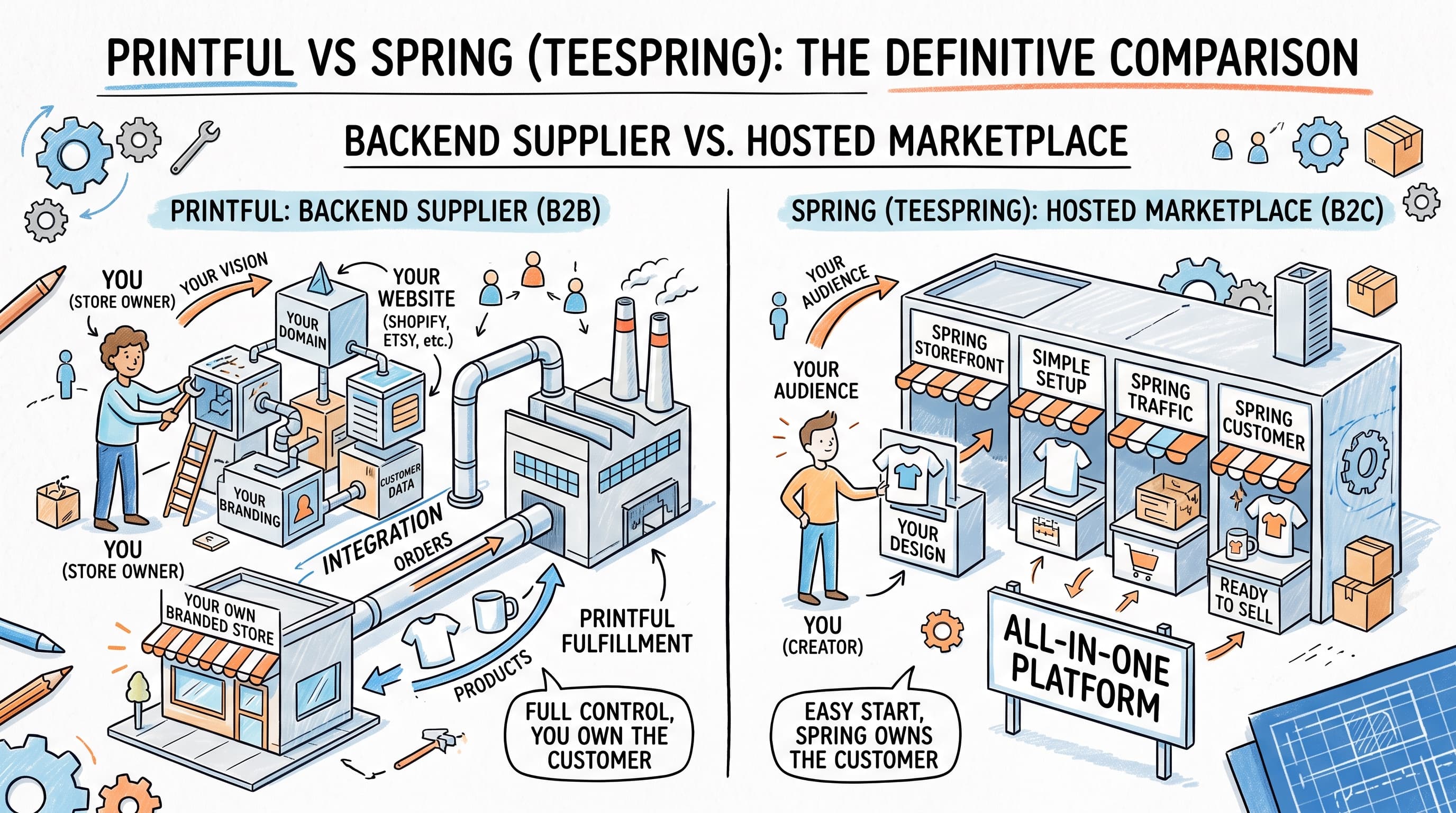
Selecting a print-on-demand fulfillment partner is one of the most critical structural choices a new e-commerce entrepreneur makes. This single decision dictates your profit margins, print consistency, shipping speeds, and overall brand reputation. The choice is often complicated because the industry giants operate on entirely different frameworks. This Printful vs Spring comparison breaks down the raw data, structural differences, and actual costs of both platforms to help you choose the correct partner for your business model.
While Printful is a white-label fulfillment engine designed to connect directly with an independent store you own, Spring, formerly known as Teespring, acts as a hosted creator marketplace. Both systems eliminate the need to hold physical inventory, yet they serve entirely different goals. Below is a methodical analysis of how they match up across the metrics that impact your bottom line.
Printful vs Spring: The Verdict at a Glance
For a rapid assessment of how these services compare, this table outlines the foundational trade-offs between Printful vs Spring and Printful vs Teespring.
| Criteria | Printful | Spring (Teespring) |
|---|---|---|
| Business Model | White-label dropshipping and fulfillment | Hosted marketplace with integrated storefronts |
| Best For | Independent e-commerce brand-builders | Content creators, influencers, and artists |
| Pricing Structure | Retail price minus transparent base cost | Sales price minus base cost equals your payout |
| Product Catalog | Deep selection of premium and custom apparel | Core catalog focused primarily on basic merchandise |
| Integrations | Shopify, Etsy, WooCommerce, and 20+ others | YouTube Merch Shelf, Instagram, TikTok, Discord |
The core choice is simple. Printful functions as a silent back-end partner for businesses building an independent brand on their own domain. Spring is a marketplace that prioritizes simplicity, giving creators a basic storefront and direct social media integrations at the expense of deep branding control.
Business Models Explained: What Is Teespring and How Do They Work?
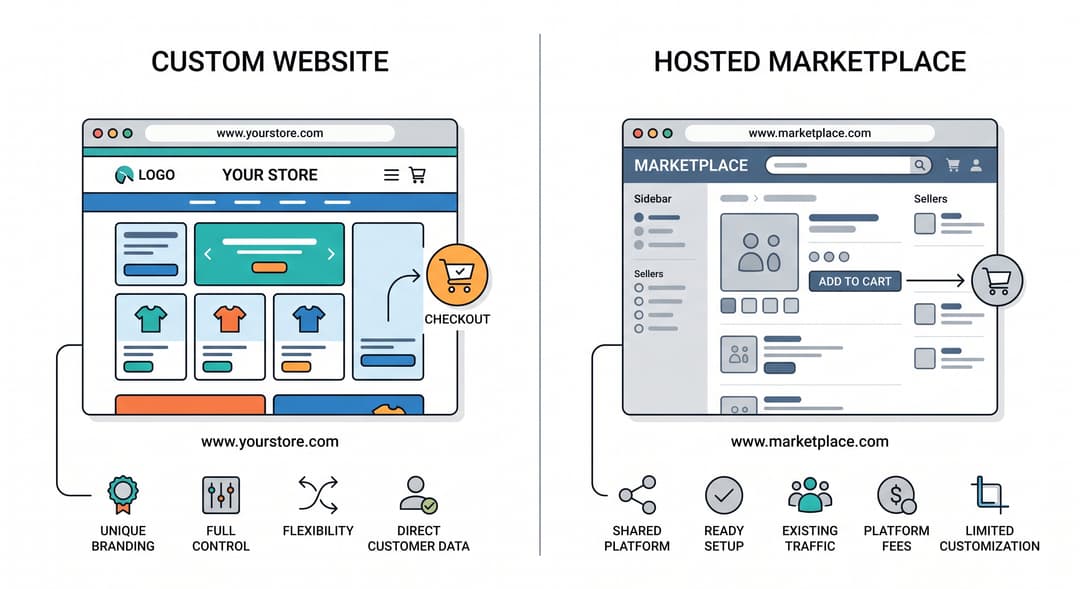
To understand how these platforms fit your business, you must look at how they manage transactions, storefronts, and customer data.
When prospective sellers ask what is Teespring, they are looking at a platform with a unique history. Founded in 2011, Teespring originally operated on a crowdfunding model where custom apparel was printed only if campaigns met pre-set sales targets. The company rebranded as Spring in 2021 to transition from crowdfunding to creator commerce. Today, Spring hosts your storefront on its platform, processes checkouts, and prints items on demand with no minimums. This setup is low-friction but limits your asset value since Spring owns the customer checkout.
Printful operates on a pure white-label model. You build a store on Shopify or Etsy, design products, and sync them to Printful. When someone buys from your site, Printful fulfills and ships the item under your brand name. This model requires more technical setup and marketing effort, but it gives you total ownership of customer lists and marketing data.
Head-to-Head Comparison: Printful vs. Spring
To help you choose between Printful vs Spring and understand how Spring vs Printful compares across daily operations, let us examine the specific features of each platform.
Pricing & Profit Margins
Both services use base-cost structures, but the margin math differs. Printful charges a fixed manufacturing cost per item. Printful lists a standard Bella + Canvas 3001 t-shirt at $11.92, with US shipping from $4.95, bringing your base cost to about $16.87 (checked October 2026). If you sell the shirt for $25.00, your gross profit is $7.51. These base costs run higher than average, making Printful a tough fit for low-budget startups.
Spring lets you set a retail price and pays you the difference after subtracting their manufacturing cost. Standard t-shirt base costs run from $9.00 to $13.00, and hoodies from $18.00 to $25.00. Creators on Trustpilot customer reviews report that these high costs squeeze margins.
Product Catalog & Quality
Product selection is another area of divergence. While both platforms cover the basics, Printful's extensive product catalog offers more depth, particularly in premium apparel and home goods categories. Printful offers specialized apparel blanks, embroidered hats, all-over-print activewear, and home goods. They also maintain a low defect rate. According to Printful's performance metrics, their global reshipment rate is just 0.24%, indicating highly consistent production quality across direct-to-garment and embroidery methods (checked October 2026).
Spring offers a streamlined catalog of merchandise essentials, such as basic tees, hoodies, socks, and mugs. Because Spring relies on a decentralized network of third-party contract printers rather than operating its own facilities, print quality can vary. Inconsistent print clarity and shifting colors are recurring complaints in user reviews. To verify quality, Printful allows you to order samples at a 20% discount, whereas Spring requires you to purchase samples at full retail price (checked October 2026).
E-commerce Integrations & API
Automating your store workflow is essential for scaling. Printful integrates natively with Shopify, Etsy, WooCommerce, Squarespace, and over 20 other sales channels. Order data, stock levels, and tracking numbers sync instantly. If you need a completely custom setup, Printful also provides a comprehensive, open API.
Spring does not integrate with standard e-commerce platforms like Shopify. Instead, its integrations are built for social media channels. It features direct links with the YouTube Merch Shelf, Instagram Shopping, TikTok, and Discord. This allows content creators to display merchandise directly beneath their content, but it leaves traditional e-commerce sellers without a viable way to connect a custom domain or run custom checkout optimization software.
Shipping & Fulfillment
Printful owns and operates fulfillment centers in the United States, Europe, Canada, and Mexico. Most orders are processed within 2 to 5 business days. Standard shipping within the United States averages 5 to 10 business days, while international shipping ranges from 7 to 20 business days. Printful utilizes localized routing, meaning an order from Germany is produced in their European facilities, minimizing import taxes and reducing shipping times.
Spring's fulfillment timeline is less consistent because it depends on third-party printing facilities. Domestic shipping averages 7 to 14 business days, and international orders frequently take 2 to 4 weeks. Customer complaints online point to occasional long delays during Q4 holiday rushes, which can complicate customer service management.
Branding & Customization

Printful is built for serious white-label branding. All outgoing packages use generic packaging with no Printful logos. You can customize the packing slip with your brand logo and insert a personalized thank-you message. Printful also supports inside and outside neck label printing on apparel, which is essential for establishing a cohesive retail brand. For a fee, you can also utilize their warehouse program to store branded stickers or custom flyers that their staff will insert into every package.
Spring offers almost no custom branding. Packages are shipped in generic or Spring-branded bags, and the checkout pages and transactional emails carry Spring's branding. Since you do not own the customer email list, you cannot execute custom email remarketing campaigns, which restricts customer lifetime value.
The Verdict: Who Should Use Printful vs. Who Should Use Spring?
Deciding between Spring vs Printful depends on your technical experience and business model.
| Best for Printful: E-commerce entrepreneurs and brand-builders who want full control over their marketing, website, and customer experience. If you plan to build a long-term business on Shopify, Etsy, or WooCommerce, Printful's print quality, extensive integrations, and white-label options make it the stronger option. |
|---|
| Best for Spring: Creators, YouTubers, and influencers who want a simple way to sell merchandise to an existing audience without managing a separate e-commerce store. Spring remains a highly convenient option for monetizing an established social media following with minimal technical setup, provided you monitor their ongoing payout and fulfillment performance. |
|---|
Putting It All Together
The printful vs spring comparison does not produce a single, universal winner. The right platform depends entirely on your business structure and marketing strategy. Printful provides the control, quality, and integrations needed to build an independent, scalable brand, though it requires you to manage your own traffic and accept higher base costs. Spring provides a frictionless, zero-cost starting point with integrated social media features, but limits your brand ownership and long-term customer equity.
For independent store owners, choosing Printful is the logical path to building an enterprise. For social media influencers looking to monetize fans, Spring provides a quick path to market. Carefully calculate your expected margins, order product samples, and establish clear shipping expectations for your buyers before launching your store.
FAQ
Can I connect my Printful products to a Spring storefront?
No, Printful and Spring are entirely separate platforms. Printful is a fulfillment partner that connects to e-commerce stores like Shopify and Etsy, while Spring is a closed ecosystem that hosts its own storefronts.
Does Spring handle sales tax and VAT for my orders?
Yes, because Spring acts as the merchant of record for transactions on its platform, they collect and remit sales tax and VAT. If you use Printful, you are the merchant of record, meaning you are responsible for calculating, collecting, and filing sales tax in your respective jurisdictions.
Are there monthly subscription fees for either platform?
Neither Printful nor Spring charges a monthly subscription fee for their basic services. You only pay Printful when a customer places an order, and Spring simply subtracts the product base cost from your retail price before issuing your payout.
Which platform is better for selling custom embroidery?
Printful is significantly better for custom embroidery. They offer a wide selection of hats, hoodies, and jackets with embroidery options, and their digitization fee is highly competitive. Spring focuses mostly on standard flat printing.
Keep reading
- Gooten vs. Printful: A 2026 Comparison for Sellers
Gooten vs Printful: Which is right for your store in 2026? We compare print quality, product pricing, integrations, and fulfillment models to help you decide.
- Printify vs. Spring (Teespring): Which Is Better for Creators?
Choosing between Printify vs Teespring (now Spring)? We compare the supplier and marketplace models on pricing, integrations, and branding to help you decide.
- Printful vs Gelato: Which Should You Choose in 2026?
Printful vs Gelato: A detailed 2026 comparison. We review fulfillment models, print quality, pricing, and product catalogs to help you choose the right POD partner.