Amazon Print on Demand: Merch vs. Third-Party Suppliers
Comparing Amazon print on demand options? We review the two main models: Amazon Merch on Demand vs. using a POD supplier like Printful or Printify.
· UPDATED · 12 MIN
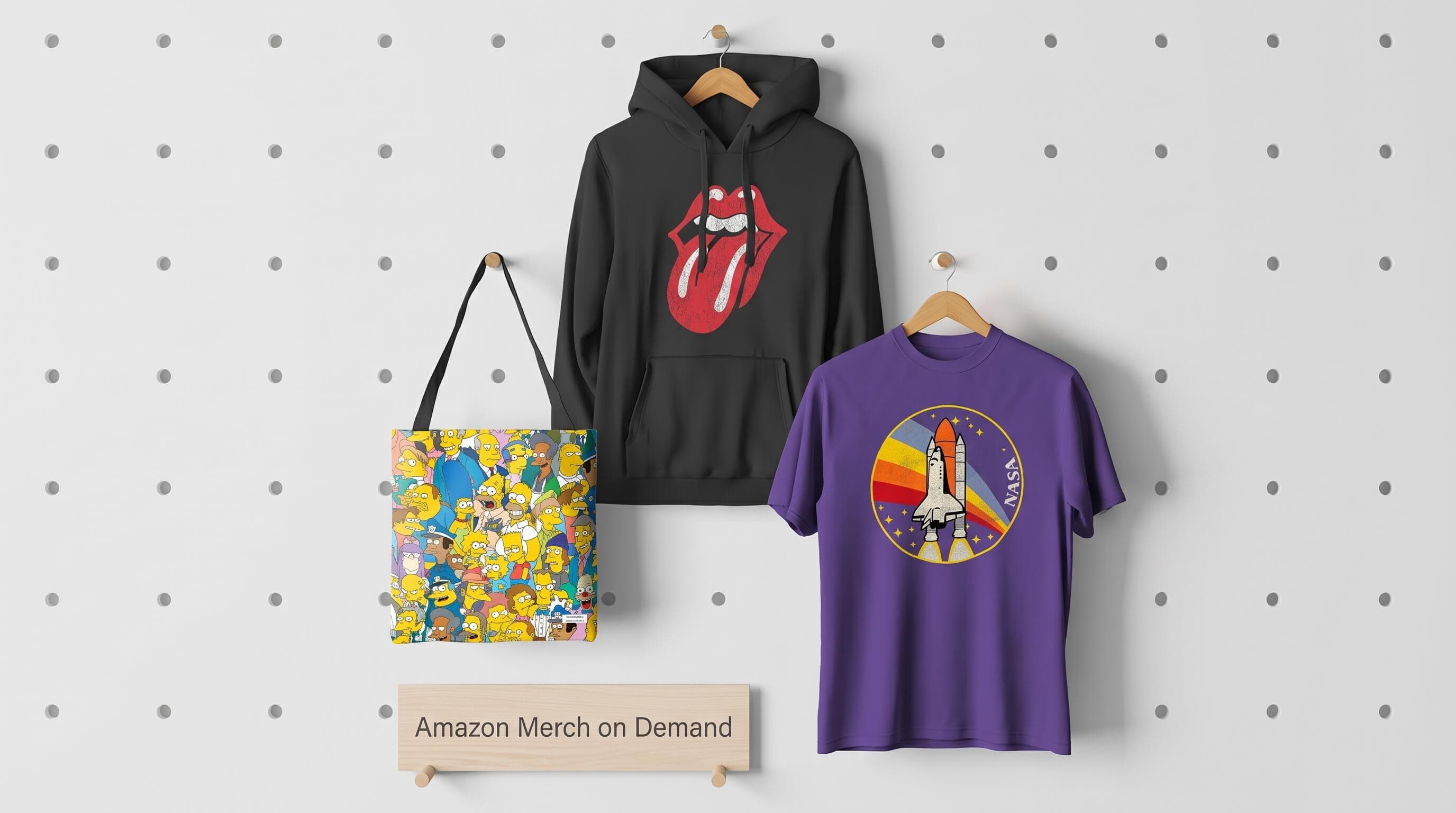
Selling custom products on Amazon presents a significant opportunity for independent creators, but navigating the options can be complex. The term “Amazon print-on-demand” doesn’t refer to a single service, but to two fundamentally different business models: Amazon’s native Merch on Demand program and the more hands-on approach of using a third-party print-on-demand (POD) supplier through an Amazon Seller Central account.
Each path offers a distinct set of trade-offs in terms of cost, control, scalability, and operational effort. This article provides a detailed, side-by-side comparison of these two models. We will examine their core mechanics, financial realities, and practical requirements to help you determine which approach best aligns with your business goals.
The Two Models for Selling POD on Amazon

Before comparing specific features, it is crucial to understand the foundational difference between the two business models. Your choice here defines your role, responsibilities, and how you earn money.
1. Amazon Merch on Demand: The Royalty Model
Amazon Merch on Demand operates as a licensing arrangement. As a creator, your primary role is to create and upload designs. Once you submit a design and choose which products to place it on (from Amazon's limited catalog), Amazon handles the rest. This includes creating the product listing, managing production, fulfilling orders, shipping to the customer, and handling all customer service and returns. You do not hold inventory or manage transactions.
For each item sold, you earn a royalty. This is a set percentage of the sale price after Amazon deducts its costs for materials, printing, and fulfillment. It is a hands-off approach that minimizes operational complexity. This distinction between a hands-off marketplace and a more integrated supplier is a common trade-off in the POD industry, which we explore further in our Printful vs Redbubble: Supplier vs Marketplace comparison.
2. Third-Party POD Supplier + Seller Central: The Direct Sales Model
This model involves running your own e-commerce store on the Amazon marketplace. You are the seller of record, which means you are fully responsible for your business. The process begins by setting up an Amazon Professional Seller account and integrating it with a third-party POD service like Printful, Printify, or Gelato.
You control the entire retail process. You choose products from your supplier's extensive catalog, create and optimize your own Amazon listings, set your own retail prices, and manage marketing and customer service. Your POD partner works in the background, automatically receiving orders, then printing and shipping the products directly to your customers. While the POD supplier handles the physical fulfillment, you own the customer relationship and the brand experience.
The cost structure is also entirely different. Instead of a royalty, you earn a profit margin. This is the difference between your retail price and the combined costs of the product's base cost, shipping, Amazon's monthly account fee, and its referral fees (a percentage of each sale). According to the Amazon Seller Central pricing page, the Professional plan is a monthly subscription, and referral fees vary by product category. This model requires more active management and financial planning but offers substantially more control and potential for brand building.
Our Review Criteria for Amazon POD Solutions
To provide a clear and balanced comparison, we evaluate both Amazon print-on-demand methods against a consistent set of criteria. Understanding these factors is key to identifying the trade-offs inherent in each model and selecting the one best suited to your resources and ambitions.
- Business Model & Fees: This examines how you generate revenue and the associated costs. We look at the difference between a royalty system and a profit margin model, accounting for all platform fees, subscription costs, and production expenses.
- Product Range & Quality Control: This criterion assesses the variety and depth of the available product catalog. It also considers the level of control a seller has over the final product's quality and consistency, a critical factor for brand reputation.
- Pricing & Profit Control: We evaluate the seller's autonomy in setting retail prices. This directly impacts the potential profit margin and the ability to run promotions, test pricing strategies, or bundle products.
- Branding & Customer Ownership: This looks at the opportunities to build a distinct brand identity through custom packaging, packing slips, and other branding elements. It also covers access to customer data, which is vital for marketing and building long-term relationships.
- Ease of Setup & Operations: This measures the technical and administrative workload required to launch and maintain the business. It includes the initial setup process, day-to-day order management, and customer service responsibilities.
- International Reach & Scalability: This criterion assesses the platform's ability to support sales across multiple countries and handle a growing volume of orders without compromising performance or requiring significant process changes.
Amazon Print on Demand: Head-to-Head Comparison Table
The following table summarizes the key differences between Amazon Merch on Demand and leading third-party POD suppliers. Use this as a quick reference to see how each option stacks up against our review criteria. The details behind these comparisons are explored in the sections that follow.
| Feature | Amazon Merch on Demand | Printful | Printify | Gelato | Gooten |
|---|---|---|---|---|---|
| Integration Method | Native Amazon program | Direct API Integration | Direct API Integration | Direct API Integration | Direct API Integration or via Middleware |
| Setup Difficulty | Low (Invitation/application-based) | Medium (Requires Seller Central setup) | Medium (Requires Seller Central setup) | Medium (Requires Seller Central setup) | Medium (Requires Seller Central setup) |
| Product Range | Limited (Primarily apparel & accessories) | Extensive (Apparel, home goods, accessories) | Very Extensive (Large network of suppliers) | Extensive (Apparel, wall art, stationery) | Curated (Apparel, home goods, pet products) |
| Pricing Control | Limited (Set by Amazon's royalty structure) | Full Control | Full Control | Full Control | Full Control |
| Branding Options | None (Amazon-branded) | Custom labels, packing slips, pack-ins | Varies by provider; some offer branding | Custom packing slips | Custom neck labels, packing slips |
| Customer Ownership | None (Amazon owns the customer relationship) | Full (You are the seller of record) | Full (You are the seller of record) | Full (You are the seller of record) | Full (You are the seller of record) |
| Fee Structure | Royalty-based (No upfront cost) | Seller plan + Referral fees + Base costs | Seller plan + Referral fees + Base costs | Seller plan + Referral fees + Base costs | Seller plan + Referral fees + Base costs |
| Fulfillment | Handled by Amazon | Handled by Printful | Handled by Printify's network | Handled by Gelato's network | Handled by Gooten's network |
| International Selling | Supported in select Amazon marketplaces | Supported across North America & Europe | Direct integration primarily for Amazon US | Supported via a global production network | Supported via a global production network |
| Best For | Passive income, testing designs, no overhead | Brand builders wanting quality & branding | Sellers prioritizing low base costs & variety | Sellers focused on global, localized sales | Businesses needing a curated, reliable catalog |
A Closer Look: Amazon Merch on Demand
.jpeg&w=1080&q=75)
Amazon Merch on Demand is a streamlined, low-risk entry point into the world of e-commerce. It is designed for creators who want to monetize their designs without the complexities of running a retail business. Its defining characteristics are simplicity and a near-total lack of operational responsibility.
To get started, you must apply or be invited to the program, which is detailed on the official Amazon Merch on Demand site. New accounts operate on a tier system. A Tier 10 account, for example, can only have 10 active designs at any one time. To advance to higher tiers with more design slots, you need to generate sales. This tiered structure gates growth and requires creators to prove their designs are commercially viable before they can expand their portfolio.
The product catalog is focused on high-volume, simple items. It primarily includes T-shirts, hoodies, sweatshirts, PopSockets, phone cases, and tote bags. While the selection is reliable, it lacks the depth and variety found with third-party suppliers, making it difficult to build a niche brand around unique products.
Your earnings are based on a fixed royalty structure. Amazon sets a list price for each product, from which it subtracts its costs (materials, printing, shipping, customer service, etc.). The remainder is your royalty. For example, a T-shirt listed at $19.99 might earn you a royalty of approximately $5.23. You have some ability to adjust the list price, which directly impacts your royalty, but you cannot control the underlying costs that Amazon calculates.
Pros of Amazon Merch on Demand:
- Simplicity and Zero Overhead: There are no monthly fees, no inventory to manage, and no need to handle shipping or customer service. You upload a design, and Amazon does the rest.
- Access to Amazon's Customer Base: Your products are listed on one of the world's largest marketplaces, potentially discoverable by millions of shoppers.
- Prime Shipping Eligibility: Products sold through Merch are eligible for Amazon Prime, a powerful conversion driver that provides fast, free shipping to Prime members.
- No Financial Risk: You are not charged for production. You only earn a royalty when a product sells, eliminating the risk of unsold inventory or upfront production costs.
Cons of Amazon Merch on Demand:
- No Branding: All products are shipped in Amazon-branded packaging. You have no ability to include custom labels, packing slips, or other materials to build your brand identity.
- No Customer Data: Amazon owns the customer relationship. You do not receive any customer information, making it impossible to build an email list or conduct remarketing campaigns.
- Limited Product Selection: The catalog is narrow compared to dedicated POD suppliers, restricting creative and commercial opportunities.
- Lower Profit Potential: The royalty model typically results in lower per-item earnings compared to the profit margins possible when setting your own prices through Seller Central.
- Lack of Control: You have limited control over your product listings, backend keywords, and overall presentation, which can hinder optimization and sales velocity.
A Closer Look: Third-Party POD Suppliers via Seller Central

Using a third-party POD supplier with an Amazon Seller Central account is akin to building a fully-fledged business. This path demands more effort and initial investment, but in return, it provides complete control over your products, branding, pricing, and growth strategy. It is the preferred model for serious entrepreneurs aiming to build a sustainable brand.
Essential Setup & Requirements
Getting started requires several key steps. First, you must sign up for an Amazon Professional Seller account, which carries a monthly subscription fee (currently $39.99 in the US) (checked October 2026). This account level is necessary to get the API access required for most POD services to automate order processing.
A common hurdle for new sellers is the need for product identifiers like UPCs. Since print-on-demand products are custom-made and do not have existing barcodes, you must apply for a GTIN (Global Trade Item Number) Exemption from Amazon for your brand and product category. This is a critical, often-overlooked step that allows you to list your unique products without purchasing barcodes for every design variation.
Key Operational Considerations
Operating as the seller of record comes with significant responsibilities. You must adhere to all of Amazon's performance metrics, including shipping times and customer service response rates. It is also a violation of Amazon's policies for a third-party retailer's branding to appear on packaging. You must ensure your POD partner ships items with neutral packaging or with your branding, not their own.
Cash flow management is another crucial aspect. When a customer places an order, your POD supplier will charge you for the base cost of the product and shipping immediately. However, Amazon typically holds your sales revenue and pays it out on a 14-day cycle (and potentially longer for new accounts). This means you need sufficient working capital to cover production costs before you receive the customer's payment from Amazon.
Leading Supplier Integrations
Several established POD companies offer integrations with Amazon, each with distinct strengths.
- Printful: Printful operates its own production facilities, which provide a high degree of control over print quality and fulfillment consistency. Its catalog is extensive, and it offers strong branding options, including custom neck labels, packing slips, and package inserts. For sellers targeting customers across North America and Europe, Printful offers one of the most robust and geographically diverse direct integrations with Amazon. You can find detailed instructions in Printful's official Amazon integration guide, which covers setup across multiple regions.
- Printify: Printify is a POD network that connects sellers with a vast array of independent print providers around the world. Its primary strength lies in its exceptionally broad product catalog and highly competitive base costs, which can lead to better profit margins. On balance, this network model introduces a trade-off: print quality and fulfillment times can vary between providers. According to Printify's Amazon integration documentation, its direct integration is currently focused on the Amazon US marketplace.
- Other Providers Worth Considering:
- Gelato: Gelato's key advantage is its global network of over 100 production partners in more than 30 countries. This model emphasizes localized production, which can lead to faster shipping times, lower shipping costs, and a reduced carbon footprint for international orders. It is a strong choice for sellers with a global customer base.
- Gooten: Gooten offers a curated product catalog with a focus on unique and high-quality items, such as home decor and pet products. It provides a more managed experience and is often favored by businesses looking to scale with a reliable partner. Its Amazon integration is robust and designed to handle significant order volumes.
The Verdict: Which Amazon POD Path Should You Choose?
After a thorough review of both models, the verdict is clear: the right choice depends entirely on your goals, resources, and how actively you want to manage your business. The core trade-off is simplicity versus control.
Amazon Merch on Demand is best for:
- Designers and Artists: Individuals who want to focus exclusively on creating art and monetizing their portfolio without any operational burdens.
- Passive Income Seekers: Anyone looking for a low-effort way to generate revenue from their designs with almost no financial risk or time commitment for management.
- Market Testers: Sellers who want to validate the commercial appeal of specific designs or niches before investing in building a full-fledged brand.
On balance, Merch on Demand is an excellent, risk-free entry point. Its limitations in branding, product selection, and profit potential, however, make it less suitable for building a long-term, scalable business.
Third-Party POD Suppliers are best for:
- Brand Builders: Entrepreneurs who are serious about creating a distinct brand identity with custom labeling, unique products, and direct customer engagement.
- Sellers Needing Catalog Depth: Businesses that require a wide or specialized range of products beyond basic apparel to serve a specific niche.
- Merchants Seeking Control: Sellers who want to command their own pricing, run marketing campaigns, optimize listings, and own their customer data for future growth.
- Established Businesses: Existing e-commerce stores (e.g., on Shopify or Etsy) looking to expand their sales channels to Amazon's massive marketplace while maintaining brand consistency.
This path requires more work, including managing compliance, customer service, and cash flow. However, the reward is a true business asset with significantly higher potential for profit and long-term brand equity.
Conclusion
Choosing your approach to Amazon print-on-demand is a strategic decision between two distinct and viable business models. Neither is inherently superior; they simply serve different objectives. Amazon Merch on Demand offers a frictionless, royalty-based system ideal for monetizing creativity with minimal effort. In contrast, partnering with a third-party POD supplier via Seller Central provides the control and tools necessary to build a scalable, independent brand on the world's largest online marketplace.
By understanding this fundamental trade-off between simplicity and control, you are now equipped to select the path that best aligns with your creative and commercial ambitions. Whether you are testing the waters with a few designs or building an e-commerce empire, there is a clear route to selling your custom products on Amazon.
FAQ
Do I need an Amazon Professional Seller account to use a POD supplier?
Yes, for almost all direct integrations, the Professional Seller plan is required to gain the necessary API access for order automation. This plan currently costs $39.99 per month in the US.
Can I sell the same designs on Merch on Demand and through a third-party POD supplier?
Yes, provided you own the intellectual property rights to the design, you are free to sell it across multiple channels and platforms simultaneously.
What are Amazon's referral fees for print-on-demand products?
Referral fees vary by category but are typically 17% for clothing and accessories. It is essential to check Amazon's current fee schedule for your specific product category, as these rates can change.
How do I handle customer returns?
With Merch on Demand, Amazon manages all customer service and returns. When using a third-party supplier, you are the seller of record and must create a returns policy that complies with Amazon's standards and coordinate any returns with your POD partner.
Keep reading
- Best Print-on-Demand for Shirts in 2026: 6 Suppliers Compared
Find the best print on demand shirts supplier for your brand in 2026. We compare Printful, Printify, Gelato, and more on print quality, pricing, and catalog depth.
- Amazon Merch on Demand Review: Worth It in 2026?
An in-depth Amazon Merch on Demand review for 2026. We analyze the new royalty system, realistic earnings, and key trade-offs to answer: is it still worth it for creators?
- Best Print-on-Demand for Etsy in 2026: 5 Platforms Compared
Choosing the best print-on-demand for Etsy? We compare Printify, Printful, and more on integration, product quality, and cost to help you find the right partner for 2026.