Printify Review 2026: Pricing, Quality & Is It Worth It?
Printify Review 2026: Pricing, Quality, and Verdict
· UPDATED · 8 MIN
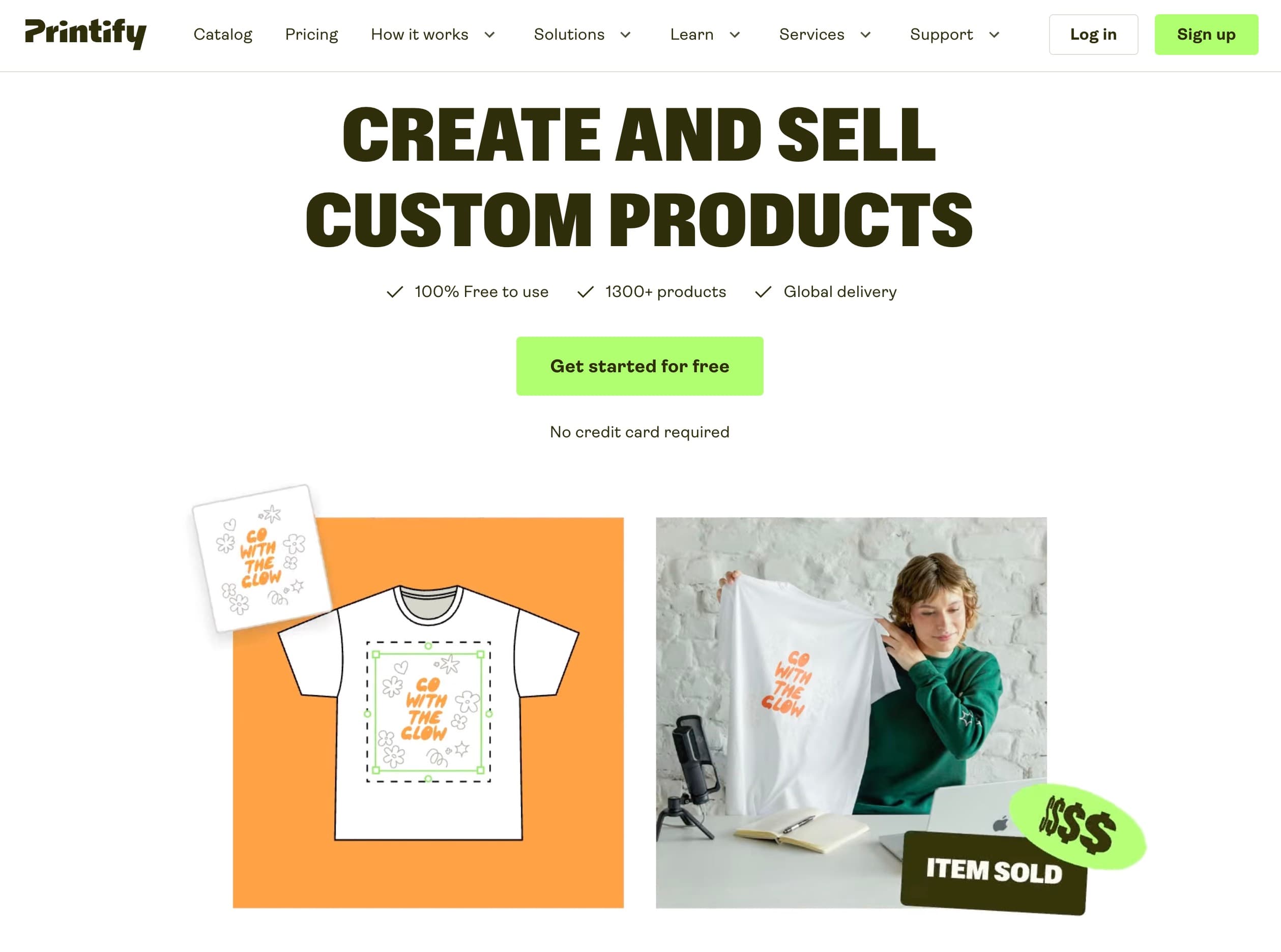
Choosing a print-on-demand partner is one of the most consequential decisions an early-stage e-commerce seller makes. Get it right, and you can focus your energy on design and marketing. Get it wrong, and you inherit a continuous stream of quality complaints and refund requests. This hands-on Printify review takes a measured look at the platform's pricing structures, product quality, and overall business value to help you decide whether it fits your operational needs.
What Is Printify & How Does Printify Work?
To build a sustainable brand, you must understand the underlying mechanics of your fulfillment partners. The single most important concept for a new seller to grasp is that Printify is not a printing company. It is a technology platform that acts as a software marketplace connecting e-commerce merchants with a decentralized network of independent print providers.
So, how does printify work in practice? Instead of managing its own printing facilities, Printify operates the entire software layer. This includes the global catalog, the online mockup generator, the automated order-routing engine, and native sales-channel integrations. When a customer purchases an item from your store, Printify automatically routes that order to the specific print provider you selected during the setup phase. That partner prints, packs, and ships the product directly to your customer under your brand name.
This decentralized model relies on a global print provider network consisting of over 140 print partners distributed across the United States, Canada, the United Kingdom, Australia, China, and various European nations. This global reach allows you to select regional providers to minimize shipping times and customs fees.
For order automation, Printify supports seamless e-commerce integrations with the major platforms used by modern sellers. On the free tier, you can connect up to five active stores. The integration suite natively connects with Shopify, Etsy, WooCommerce, eBay, Walmart, TikTok Shop, Wix, and Squarespace. Once connected, your store operates on a zero-inventory model: you only pay for fulfillment after a customer pays you, removing upfront inventory risk.
Printify Pricing Plans Explained
Evaluating Printify pricing requires looking past the monthly subscription costs to examine how base product prices directly impact your long-term profit margin. Printify offers a clear freemium structure split into two main plans for growing businesses, alongside a custom Enterprise tier for high-volume enterprises.
The free plan requires no credit card to register and has no trial expiration date. You only pay the base product cost and shipping fees when an actual customer order comes through. The premium plan was updated on February 17, 2026, to a monthly fee of $39, according to data from PodVector. However, selecting the annual billing option locks in a rate of $299 per year (equivalent to $24.99 per month), which offers a cost reduction of $169 annually compared to paying month-to-month (checked October 2026).
| Feature | Free Plan | Premium Plan |
|---|---|---|
| Monthly Cost | $0 | $39/month (or $24.99/month billed annually) (Oct 2026) |
| Active Store Limit | 5 stores | 10 stores |
| Product Discount | None | Up to 20% off most items (up to 33% on select products) |
| Product Designs | Unlimited | Unlimited |
| API Integration | Yes | Yes |
Sources: Pricing details are documented by Chayaani and PodVector, confirming that the Premium tier doubles your store capacity and provides substantial margins on high-demand inventory.
Calculating the Premium Plan Break-Even Point
To determine if Printify Premium is a logical investment, you must analyze your monthly sales volume. Let us calculate the profit potential on a popular apparel item: the Bella + Canvas 3001 unisex t-shirt.
On the Free Plan, the standard base cost for this t-shirt is approximately $12.00 (excluding shipping). If you retail this item for $22.00, your gross profit margin before shipping and platform fees is $10.00 per unit.
On the Premium Plan, the Premium discount reduces the base product cost of the same t-shirt by roughly 20%, bringing it down to approximately $9.60. Selling the shirt at the same $22.00 retail price increases your gross profit to $12.40 per unit, which represents a savings of $2.40 per shirt.
To cover the $39.00 monthly subscription fee, we divide the fee by our per-unit savings ($39.00 / $2.40 = 16.25). As highlighted by EcommerceCEO, you need to sell approximately 16 to 17 t-shirts per month to break even on the monthly Premium plan. If you opt for the annual billing plan at $24.99 per month, your break-even point drops to just 10 to 11 t-shirts per month.
For sellers starting out, the Free plan is the safest starting point. However, once your store consistently averages more than 15 orders per month, upgrading to Premium is financially advantageous.
Printify Quality Review: Assessing Product Consistency
When evaluating any print-on-demand platform, product quality remains the most critical variable. In our testing, the primary trade-off of Printify's marketplace model is quality variance. Because your products are printed by third-party facilities, consistency is not uniform across the platform; instead, it depends on the specific print partner you assign to each product listing.
This structure presents both a challenge and an opportunity. The challenge is that you cannot assume a t-shirt printed in California will match the print density of the same shirt printed in Europe. The opportunity is that Printify grants you the autonomy to review and select your print partner based on performance metrics, physical proximity, and direct customer reviews.
Real-world seller feedback highlights this dynamic. One veteran merchant noted that while Printify offers some of the most competitive base prices and fast production times, consistency can require some oversight. They noted that print partners usually correct mistakes, but achieving perfection on the first attempt is not guaranteed.
Even highly regarded print providers, such as Monster Digital, draw varied feedback from high-volume sellers. One experienced merchant explained that they route most apparel orders to Monster Digital and sample extensively, but still observe occasional variances in print saturation. However, they noted that Printify's platform design makes it easy to switch providers if quality levels fluctuate.
A Practical Guide to Selecting Print Partners
To navigate this variance, we recommend a methodical selection process using five distinct criteria, aligned with professional sourcing strategies suggested by Merch Titans:
- Provider Rating: Printify assigns an internal performance score (out of 10) to each partner, calculated from fulfillment rates, quality scores, and speed. Filter for partners holding a 9.0 or higher.
- Production and Shipping Times: Evaluate the average fulfillment speed of each partner. A slightly cheaper provider that takes five days to process an order can harm your customer retention.
- Shipping Location: Choose print locations close to your target audience. For example, assign a US-based partner for American customers and a European partner for EU customers to avoid international shipping delays.
- Review History: Check recent merchant forums and community reviews for specific partners, as operational capacity can change during high-volume quarters.
- Peak Season Resilience: Monitor provider performance during Q4, as high demand can expose limitations in lower-rated fulfillment operations.
Fulfillment Tip:
Ordering physical samples is a mandatory step before launching any product to the public. Testing sample products allows you to physically inspect fabric quality, print placement, and color accuracy. Note that Printify does not offer free samples; all test orders must be paid for at standard base rates plus shipping. We advise budgeting $50 to $100 for test orders to verify color rendering across different print methods before launching.
Printify Review Pros Cons: The Good and the Bad
To help you make an informed business decision, let us summarize the core operational trade-offs of the Printify platform.
| Pros | Cons |
|---|---|
| Extensive Product Catalog: Over 900 customizable items, offering exceptional catalog diversity across apparel, home goods, and accessories. | Variable Print Quality: Print consistency varies between independent print providers across the network. |
| Competitive Base Pricing: Highly competitive unit costs, especially when utilizing the Premium plan discounts. | Decentralized Accountability: Printify acts as a mediator; resolving physical printing errors involves a multi-party resolution process. |
| Fulfillment Flexibility: Merchants can easily select and switch print providers based on customer locations or pricing changes. | Split Shipping Fees: If a single customer order contains items printed by different partners, you will pay separate shipping charges. |
| No Upfront Costs: The Free plan has no monthly fees or store-creation barriers, making it highly accessible. | Sampling Costs: You must purchase sample items at standard pricing to verify quality, as free samples are not offered. |
Following up with Merch Titans analysis, Printify's primary competitive advantage is its massive catalog breadth, which is unmatched by most single-source print-on-demand competitors. However, the operational trade-off is the mediation model of customer support. Because Printify is not the direct manufacturer, its support agents act as intermediaries between you and the print provider when an error occurs. While Printify works with print partners to resolve claims with replacements or refunds within a few business days, this mediation layer can add communication delays during high-volume periods like Q4.
The Verdict: Is Printify Worth It in 2026?
On balance, is Printify worth your time and capital? The final verdict is yes, provided you understand and accept the platform's structural trade-offs. If you prioritize low unit costs, catalog variety, and the freedom to source from multiple print providers, Printify is an exceptional operational partner. Conversely, if your business model demands a single point of operational accountability and completely standardized packaging, a centralized competitor may suit you better.
To help clarify this choice, Printify is the optimal partner for these specific seller profiles:
- Sellers Prioritizing Profit Margins: If you sell on price-sensitive platforms like Etsy where base cost directly dictates competitiveness, Printify's low product costs are highly advantageous.
- Niche Brands Requiring Diverse Catalogs: If you plan to sell unique, non-standard items alongside standard apparel, the breadth of Printify's inventory provides a significant advantage.
- Bootstrap Startups Using Shopify: If you are validating designs on a limited budget, the free tier allows you to launch and integrate with Shopify without upfront monthly software overhead.
For online merchants who fit this operational profile, the most practical next step is to evaluate the system directly. You can create a free Printify account to explore the extensive product catalog, upload test graphics into the mockup generator, and check regional shipping rates without financial commitment.
What This Means for Your Store
To summarize our printify review, the platform represents a highly scalable fulfillment solution that trades absolute consistency for competitive pricing and choice. By utilizing a decentralized marketplace network, Printify empowers you to optimize your margins, but places the responsibility of quality control and provider selection directly on your shoulders.
If you are willing to order samples, vet print partners systematically, and manage customer service proactively, Printify is a powerful tool to scale an online business. The most reliable way to make an informed decision is to register for their free plan, design a couple of test items, and order samples to judge the physical quality for yourself.
FAQ
Can I use Printify with Shopify and Etsy at the same time?
Yes. Printify allows you to connect up to five active stores on its Free plan and up to ten stores on the Premium plan. You can link a Shopify storefront and an Etsy store to a single Printify dashboard and manage your custom products across both sales channels.
How long does Printify take to print and ship items?
Fulfillment times depend on the specific print provider you select. On average, most print partners process and print items within two to seven business days. Shipping times vary based on the destination and the print partner's physical location, with domestic shipping in the United States typically taking an additional two to five business days.
What happens if a Printify order is damaged or lost?
If an item arrives damaged or is lost in transit, Printify manages the resolution process. You must submit photographic evidence of the damage through your merchant dashboard within thirty days of delivery. Printify will work with the print provider to issue a replacement or refund, which is typically processed within a few business days.
Does Printify offer custom packaging or branding?
Because Printify relies on a network of independent third-party printers, options for custom branding, such as custom neck labels or branded packaging inserts, are limited and depend on the specific print provider. Most orders ship in standard, neutral poly mailers with no Printify branding, ensuring your brand remains front and center.
Keep reading
- Gelato Review 2026: Pricing, Quality & Our Verdict
A complete Gelato print on demand review for 2026. We cover pricing, product quality from our tests, and shipping speeds to help you decide if it's worth it for your store.
- Printful Review 2026: Pricing, Quality & Is It Worth It?
Our printful review breaks down 2026 pricing, DTG print quality, shipping speed, and the real cost gap vs Printify, so you know if it fits your store.
- Printify vs. Gelato: Which Is Better for Your Store in 2026?
Choosing between Printify vs Gelato? Our 2026 review compares pricing, product catalogs, shipping, and fulfillment models to help you find the best fit for your store.