Printful vs Printify 2026: Which POD Platform Wins?
Comparing Printful vs Printify? See real 2026 profit margins, quality trade-offs, and branding options side by side, then find out which one fits you.
· 8 MIN
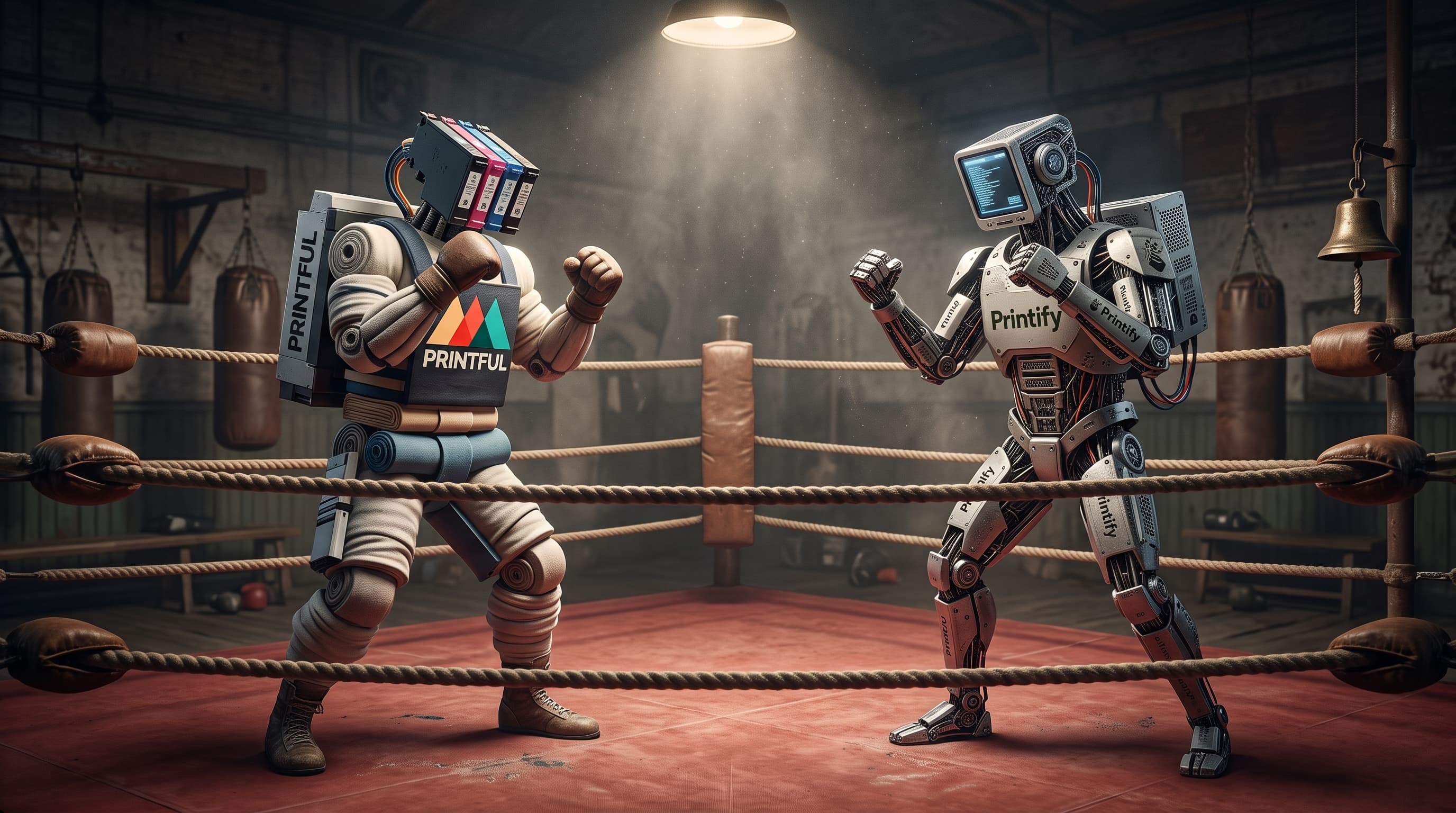
Choosing a fulfillment partner is one of the earliest, most consequential decisions you will make as an e-commerce entrepreneur. Get it right, and you establish a reliable operational engine. Get it wrong, and you inherit customer complaints, slow shipping, and thin margins. This Printful vs Printify comparison goes past the feature checklists to examine what actually determines success in 2026: true profitability and long-term viability for a growing brand.
To make an informed choice, a thorough printful vs printify print on demand comparison is necessary. The stakes are high, the global print-on-demand market was valued at USD 10.8 billion in 2025 and is projected to grow from USD 13.1 billion in 2026 to USD 57.5 billion by 2033.
The core tension in the Printify vs Printful debate represents a fundamental trade-off: Printify's flexibility and low costs versus Printful's consistency and all-in-one service. The correct choice depends on which operational model matches your business goals.
At a Glance: Printful vs Printify Comparison
For those seeking an immediate summary, the table below provides a high-level Printful vs Printify comparison. This overview highlights the core operational distinctions, focusing on key features, pricing structures, and print quality.
| Criteria | Printful | Printify |
|---|---|---|
| Business Model | In-house, vertically integrated fulfillment | Marketplace of third-party print providers |
| Pricing Structure | Free plan; Growth at $24.99/mo | Free plan; Premium at $39/mo ($24.99/mo annual) |
| Best for Quality | Consistent, standardized output | Variable, depends on chosen provider |
| Best for Price | Higher base costs | Lower base costs, provider competition |
| Branding Options | Extensive (labels, pack-ins, packaging) | Solid but limited by provider |
| Product Catalog | Curated, in-house range | Larger catalog across many suppliers |
The core trade-off can be summarized simply: Printify leverages competitive vendor pricing to reduce upfront costs, whereas Printful controls the entire production line to guarantee consistent quality.
Pricing & Profitability: The True Cost in 2026
Pricing analysis only becomes useful when you separate software fees from the per-order costs that actually shape your profit margin. Both platforms offer functional free tiers alongside paid subscription plans designed to lower your per-unit costs as your store scales.
Printful utilizes a simple tiered model. The Free plan carries no monthly fees, while the Growth plan is priced at $24.99 per month. The Growth tier offers up to 33% off base product costs, a 9% discount on custom branding, 25% off sample orders, and free embroidery digitization. This subscription becomes free once your trailing 12-month Printful sales cross $12,000, presenting a logical path for scaling businesses.
Printify recently updated its premium tier pricing. As of February 17, 2026, the monthly price for Printify Premium is $39 per month, though billing annually reduces this to $299 per year, which averages $24.99 per month. The Premium plan's headline benefit is an approximate 20% discount on catalog items. The Premium plan also supports 10 connected stores, priority support, and access to Printify Connect, an order tracking management tool.
True Profit Calculation. To model your actual profit margin, we must evaluate the total landed cost of a popular item. Below is a cost breakdown for a Bella + Canvas 3001 t-shirt shipped to a domestic US address, using current 2026 rates.
| Cost Component (US, Bella + Canvas 3001) | Printful (Growth Plan) | Printify (Premium Plan) |
|---|---|---|
| Base Product Cost | ~$11.50 | ~$9.00 (Monster Digital) |
| US Shipping Costs (First Item) | ~$4.29 | ~$4.00 to $4.99 |
| Monthly Subscription Share (At 50 sales/mo) | ~$0.50 | ~$0.50 to $0.78 |
| Approximate Total Landed Cost | ~$16.29 | ~$13.50 to $14.77 |
The base cost differences between these platforms remain consistent across most popular items. In a detailed t-shirt comparison published by PodVector, data showed a base price gap of approximately $1.33 for the Bella + Canvas 3001 blank. This price gap expands on basic items. For instance, testing on a Gildan 64000 blank showed Printify's base cost at roughly $8.00, compared to Printful's base cost of approximately $12.00.
When calculating the break-even point for paid subscriptions, Printful's Growth plan typically pays for itself at around 10 to 15 apparel orders per month. The Premium plan's 20% discount pays for itself once your store processes 15 to 20 orders per month.
The financial verdict: Low-volume sellers testing new designs benefit from either platform's free plan. High-volume sellers focused on maximizing margins will find Printify's lower base costs highly advantageous, while those looking to build a premium brand can utilize Printful's Growth tier to mitigate higher base expenses.
Product Quality & Branding: In-House vs. Marketplace Model
This is where the two platforms diverge most sharply, and where product quality, print quality, and branding options are decided by structure rather than marketing.
The key difference lies in their fulfillment models. Printify operates a marketplace, connecting you with a large network of print providers. In contrast, Printful's in-house print-on-demand model means they handle nearly all production and shipping themselves, which offers a different set of trade-offs around quality control.
Printify's Marketplace Model. Printify's strength is catalog breadth and supplier competition its primary advantage lies in its extensive supplier network, larger overall product catalog, and competitive pricing. Because multiple independent suppliers compete for your orders, base costs remain low. However, this decentralized structure introduces quality variation. A design printed by one supplier may have subtle differences in color, alignment, or ink thickness compared to the same design printed by another. Sellers must order samples from different providers to ensure consistency.
While other competitors like Gelato offer global print networks, Printify remains the largest decentralized alternative. Sellers often use design tools like Canva to build assets before importing them into Printify's platform, but must actively manage which print partners handle their orders.
Printful's In-House Model. Printful operates its own facilities, which leads to highly standardized quality control. The Style Factory review notes that Printful provides more consistent in-house fulfillment, broader branding options, and an advanced product designer. Because Printful owns the machinery and trains the technicians, the output remains uniform across orders. The trade-off is financial; you pay higher base prices to support this centralized quality assurance and customer support structure.
Branding Options. The unboxing experience is a vital touchpoint for premium brands. Printify supports custom neck labels and package inserts, but execution depends heavily on the selected supplier. Inside-neck printing is restricted to t-shirts and sweatshirts featuring tear-away labels. Furthermore, outer packaging remains generic; Printify ships orders in plain white-label mailers and boxes. Custom printed outer packaging is not supported, and only select partners like Dimona Tee, Monster Digital, SwiftPOD, Print Clever, and Duplium allow branded package inserts.
Printful offers a more uniform, comprehensive branding suite. Sellers can implement inside and outside labels, custom packing slips, branded pack-ins, and customized packaging mailers. While these options incur additional storage and handling fees, they remain highly consistent across Printful's entire catalog, allowing for a professional, cohesive unboxing experience.
Fulfillment & Shipping: Who Delivers Faster to Your Customers?
Fulfillment speed and delivery reliability directly impact customer reviews and repeat purchase rates. Let us look at how both platforms manage their shipping networks.
Production Times. Printful operates with transparent, standardized averages. Standard fulfillment takes 2 to 5 business days across most categories. Their historical performance indicates that over 97% of orders are shipped within 5 business days, and more than 50% ship within 3 business days or fewer. Printify's production times are comparable, but speed depends entirely on the chosen supplier. A highly rated provider might average 2 business days, while a backlogged provider might take 5 to 7 days during peak holiday seasons.
Shipping Networks. Printful runs several owned facilities globally. Company documentation notes that Printful operates seven in-house fulfillment centers across Europe and North America, supplemented by partner facilities in Australia, Japan, and Brazil. Printful's routing algorithm automatically sends each order to the closest facility that has the item in stock and supports the required printing method. For US sellers, facilities in North Carolina, Texas, and California ensure stable domestic shipping.
Printify relies on a broad network of independent print providers. While this means you must manage different shipping rates and times, it allows for strategic flexibility. If a customer is located in the UK, you can route the order to a UK-based provider, saving shipping costs and avoiding import delays. Most US domestic orders are handed off to USPS for final delivery across both platforms.
Integrations & Automation. Seamless order routing is essential for modern e-commerce. Printify integrates directly with 11 major platforms, including Shopify, Etsy, WooCommerce, Wix, BigCommerce, Squarespace, and TikTok Shop. Printful matches this capability, providing deep integration with Shopify, Etsy, Wix, and other top-tier channels, ensuring your orders flow from the storefront to production without manual intervention.
The Verdict: Printful or Printify in 2026?
The debate between these platforms does not have a single winner. Choosing between Printify vs Printful requires identifying which model aligns with your operational strengths and brand identity.

Choose Printify if...
You run a margin-sensitive business, want to offer a massive product catalog, and are comfortable managing relationships with different print providers. Printify is ideal for merchants selling on competitive marketplaces like Etsy, where price points are tight and margins must be defended. If you are prepared to order samples, monitor vendor performance, and optimize your shipping routes, Printify provides the tools to build a highly profitable business.

Choose Printful if...
You are building a premium, customer-first brand that requires consistent quality and cohesive unboxing experiences. Printful is the better choice for Shopify stores focused on customer lifetime value, where a single poor-quality print can ruin a customer relationship. The higher base costs are offset by the convenience of centralized support, predictable shipping speeds, and advanced customization options.
Putting It All Together
Ultimately, resolving the Printful vs Printify decision comes down to your core business priority. Printify delivers a highly competitive, flexible marketplace built to maximize your margins. Printful offers a highly controlled, integrated system designed to protect your brand consistency. Analyze your operational preferences, evaluate your budget, and select the partner that fits your long-term vision.
FAQ
Which platform is better for beginners?
Printify is often preferred by beginners due to its lower base costs, which allow for more pricing flexibility when starting out. However, Printful's simpler, all-in-one dashboard and uniform quality control make it easier to manage if you want to avoid dealing with multiple suppliers.
Can I use both Printful and Printify on the same Shopify store?
Yes, you can connect both platforms to a single Shopify or Etsy storefront. Many sellers use Printify for standard, high-margin apparel and Printful for specific premium items or complex embroidery designs.
How do shipping costs compare between the two?
Printful has standardized, predictable shipping rates across its global network. Printify's shipping rates vary depending on the print provider you select, meaning shipping can sometimes be cheaper or more expensive depending on the supplier's location.
Do Printful and Printify offer custom packaging?
Printful offers dedicated custom packaging options (such as branded mailers) and pack-ins for an additional fee. Printify does not support custom outer packaging, though select print providers allow you to include custom branded inserts inside the package.
Keep reading
- Printful Review 2026: Pricing, Quality & Is It Worth It?
Our printful review breaks down 2026 pricing, DTG print quality, shipping speed, and the real cost gap vs Printify, so you know if it fits your store.
- Printify Review 2026: Pricing, Quality & Is It Worth It?
Printify Review 2026: Pricing, Quality, and Verdict
- Best Print-on-Demand Platforms for Shopify Sellers in 2026
Find the best print-on-demand platform for Shopify in 2026. We compare Printful, Printify, Gelato, Spreadconnect, and T-Pop on pricing, quality, and fulfillment.